

A single undisclosed material fact can turn your successful $1.46 million Costa Mesa closing into a multi-year legal nightmare. Do you really want to gamble your equity on a guess? Most sellers feel overwhelmed by the sheer volume of California's mandatory paperwork, and for good reason. It's easy to feel buried under the stress of potential lawsuits. You deserve a clean, litigation-free sale where you walk away with your profit and your peace of mind intact.
Mastering what disclosures are required when selling a house in Costa Mesa is your best insurance policy against post-sale drama. We've spent decades navigating these market cycles and know exactly which boxes you must check to protect yourself. This guide breaks down the essential 2026 requirements, from the standard Transfer Disclosure Statement (TDS) to the brand-new smoking history and gas appliance mandates effective this year. Stop wondering if you've missed a detail. Use this comprehensive resource to ensure your transaction is transparent, legal, and profitable.
Key Takeaways
- Master the Transfer Disclosure Statement (TDS) to ensure every material fact is legally documented before you sign.
- Identify Costa Mesa-specific environmental hazards like liquefaction and flood zones that must be included in your Natural Hazard Disclosure (NHD) report.
- Learn exactly what disclosures are required when selling a house in Costa Mesa to shield your equity from potential lawsuits.
- Secure your sale by understanding the unique disclosure mandates for specialized assets like Residential Care Facilities for the Elderly (RCFE).
- Use pre-listing inspections as a strategic defensive move to build buyer trust and ensure a clean, litigation-free closing.
The Foundation: California’s Mandatory Transfer Disclosure Statement (TDS)
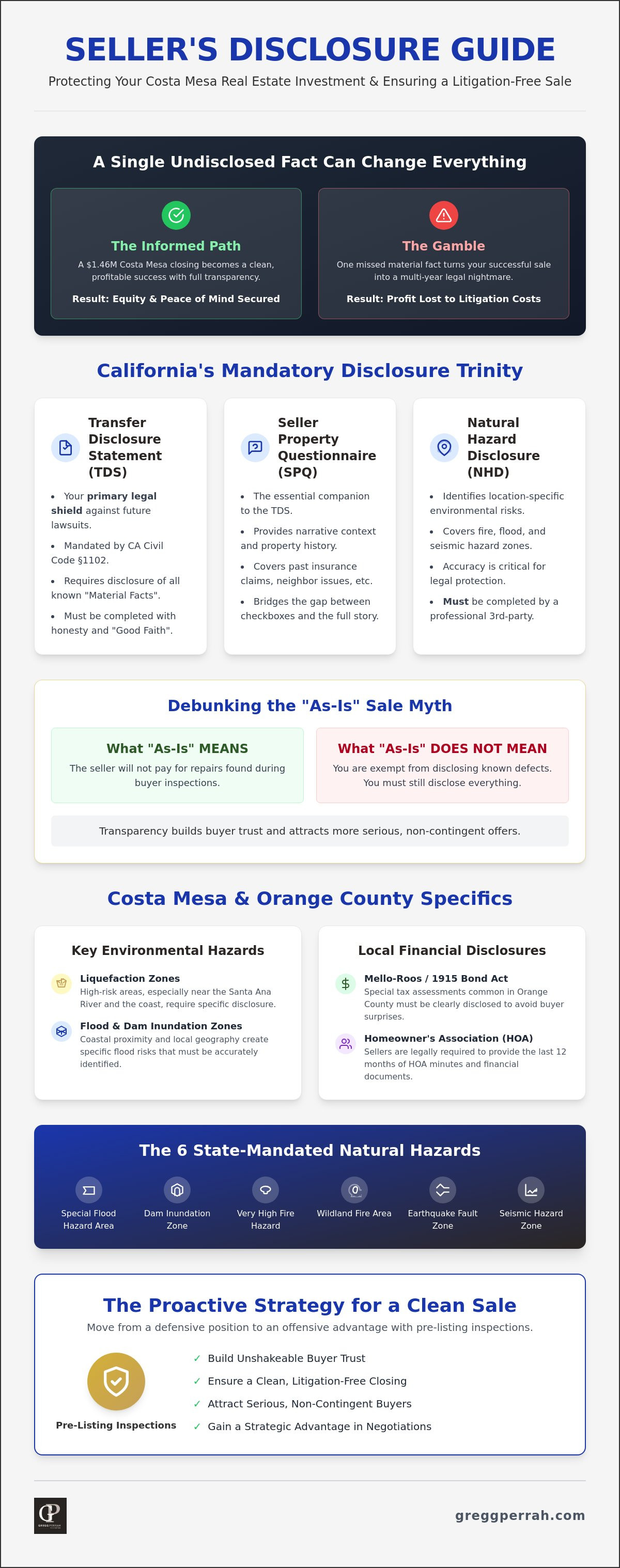
Selling a home isn't just about the final price tag. It's about legal protection. In California, the Transfer Disclosure Statement (TDS) is your primary shield. This document is mandated by Civil Code Section 1102. You must disclose every "Material Fact" you know. What does that mean? It's anything that could affect the value or desirability of your property. If you're wondering what disclosures are required when selling a house in Costa Mesa, start here. If a buyer would pay less or walk away if they knew about a problem, it's a material fact. Do not guess; disclose.
You must act in "Good Faith" at all times. This means being thorough, honest, and proactive. Don't hide that minor slab leak from three years ago or the fact that the HVAC struggles during a Santa Ana wind event. In the 2026 market, timing is everything. Provide these documents as early as possible. If you wait until after the contract is signed to deliver disclosures, the buyer gains a statutory right to rescind their offer. Why risk a failed escrow? Get ahead of the paperwork now to lock in your buyer and keep your transaction moving forward.
Along with the TDS, you'll need a Natural Hazard Disclosure Statement (NHDS) to complete the package. This covers fire, flood, and seismic risks specific to our coastal region. Together, these forms create a transparent environment for the buyer. Using a seasoned professional ensures you don't miss a single line item. We've seen how tiny omissions lead to massive lawsuits. Don't let a simple form jeopardize your equity or your future.
The Seller Property Questionnaire (SPQ)
Think of the SPQ as the essential companion piece to your TDS. While the TDS uses standard checkboxes, the SPQ digs deeper into the actual history of the home. Have you filed an insurance claim recently? Is there a noisy neighbor or a local flight path issue? You need to mention it. The SPQ is the seller's opportunity to provide narrative context to the TDS checkboxes. It bridges the gap between a "yes/no" answer and the full story of your property's condition and history. It's your chance to be heard.
The "As-Is" Sale Misconception
Many sellers think "As-Is" means they can keep secrets. It doesn't. An "As-Is" clause simply means you won't pay for repairs found during the buyer's inspections. It does not exempt you from disclosing known defects. If the roof leaks or the electrical panel is outdated, you must say so clearly. Transparency actually attracts more serious, non-contingent buyers. They appreciate the honesty and feel more confident making a firm offer. Don't hide the flaws; use them to build trust and close the deal faster. Trust is a currency in real estate.
Costa Mesa & Orange County Specifics: Hazards and Local Ordinances
Do you know if your property sits in a high-risk liquefaction zone? In Costa Mesa, the answer often depends on your proximity to the Santa Ana River or the coast. When determining what disclosures are required when selling a house in Costa Mesa, general California rules aren't enough. You need local data. The city’s unique geography means buyers are hyper-focused on soil stability and flood risks. Failing to identify these zones accurately can derail a deal or lead to mediation years later.
Beyond the dirt, you must account for the tax bill. Orange County is famous for its pockets of specialized assessments. If your home is in a newer development or a specifically improved area, you likely have Mello-Roos or 1915 Bond Act assessments. These are not optional mentions. You must provide a clear breakdown of these costs so the buyer isn't surprised by a high property tax bill after closing. For a full list of state requirements, consult the official guide on Disclosures in Real Property Transactions to stay compliant.
Natural Hazard Disclosure (NHD) Specifics
California law mandates the disclosure of six specific hazards: flood, dam failure, very high fire, wildland fire, earthquake fault, and seismic hazard. Don't try to DIY this. You must use a professional third-party NHD provider to pull the latest mapping data. Costa Mesa’s coastal proximity often flags properties for specific seismic or flood risks that a standard inspection might miss. Accuracy here is your best defense against future claims of negligence.
HOA and Mello-Roos Transparency
Are you selling a condo or a home in a planned community? You're legally bound to deliver more than just a key. You must provide the last twelve months of HOA minutes, the current budget, and the CC&Rs. Is there pending litigation against the association? Disclose it. Buyers need to know if a special assessment is looming or if the association’s reserves are depleted. Transparency prevents the buyer's remorse that fuels lawsuits. If you want to ensure your paperwork is bulletproof, review your asset valuation with an expert who understands these local nuances.
Finally, don't forget the physical compliance. Costa Mesa requires specific smoke detector placement, carbon monoxide alarms, and double-strapped water heaters. These aren't just safety suggestions; they're closing requirements. Understanding what disclosures are required when selling a house in Costa Mesa includes mastering these local ordinances before you hit the market. Verify these items are up to code before your first showing to avoid last-minute delays.
Beyond the Basics: Death, Lead, and the "Material Fact" Trap
Think disclosure is just about leaky roofs or cracked foundations? Think again. In our high-stakes local market, the "quiet" issues often cause the loudest legal battles. When you are determining what disclosures are required when selling a house in Costa Mesa, you must look beyond the physical structure. Anything that affects the desirability of the home is a material fact. This includes environmental hazards like mold, radon, or asbestos. If your property was built before 1978, federal law requires a specific lead-based paint disclosure. Don't overlook these details. A missing pamphlet can trigger federal penalties and give a buyer an easy exit strategy.
What about the "Neighbor from Hell"? It sounds like a joke, but neighborhood nuisances are legally significant. Is there a recurring noise issue from a nearby commercial center? Does a neighbor’s dog bark incessantly every night? If these factors would make a reasonable buyer hesitate, you have a duty to disclose them. Transparency is your best defense against a lawsuit for "hidden" neighborhood defects. We've spent decades protecting sellers from these exact traps. We know how to frame these disclosures to maintain buyer confidence while fulfilling your legal obligations.
The Three-Year Death Rule
California Civil Code 1710.2 is very specific. You must disclose if a death occurred on the property within the last three years. This is a mandatory requirement that many sellers find uncomfortable. How do you handle it? Be direct and professional. State the fact without unnecessary detail. What happens if the death occurred four or five years ago? Legally, the three-year clock has run out. However, if a buyer asks you a direct question about deaths on the property, you must answer truthfully. Never lie to a direct inquiry. Honesty protects your equity; evasion invites litigation.
Permit History and Unpermitted Work
Costa Mesa buyers are savvy and well-connected. Their first stop is often the city building department to check permit records. Did you finish that "bonus room" without a permit? Did you add an extra bathroom "off the books"? You must disclose unpermitted work clearly. Selling a "handyman special" with undocumented additions is a massive liability. If the city records don't match the house, the buyer will find out. Disclosing these issues upfront prevents a deal from collapsing during the appraisal or inspection phase. It also shields you from future claims that you misrepresented the square footage or the home's legal status. Take control of the narrative before the buyer’s inspector does.
- Lead-Based Paint: Mandatory for all homes built before 1978.
- Mold and Radon: Must be disclosed if known to exist.
- Neighborhood Nuisances: Includes noise, odors, or persistent disturbances.
- Permit Status: Always disclose additions or remodels done without city approval.
Understanding what disclosures are required when selling a house in Costa Mesa means being proactive. Don't wait for the buyer to discover a problem. By being transparent about everything from permit history to environmental concerns, you build the trust necessary for a smooth, litigation-free closing. You want a clean break and a full check. We make sure you get both.
Specialized Situations: Senior Living and RCFE Disclosures
Are you selling more than just a family home? If your property operates as a Residential Care Facility for the Elderly (RCFE), your disclosure obligations double overnight. You aren't just transferring real estate; you're transferring a regulated business environment. When you're determining what disclosures are required when selling a house in Costa Mesa that doubles as a business, the stakes are massive. You must protect your business reputation and your real estate equity simultaneously. This requires a level of precision that general practitioners simply cannot provide.
Seniors entering a downsizing phase often face extreme stress. Managing a lifetime of memories while navigating complex legal forms is a heavy lift. We specialize in making these high-stress transitions manageable through expert guidance. Gregg’s deep expertise in RCFE for sale opportunities ensures that every operational detail is documented correctly. We don't just list properties; we secure your financial legacy by checking every legal box before the first buyer walks through the door.
RCFE and Assisted Living Asset Disclosures
Selling an RCFE requires a dual-track disclosure process involving both CA Care Licensing and Real Estate law. You must separate the physical property disclosures from the business asset disclosures. Buyers need full transparency regarding your operational history, business licenses, and financial performance. Are your fire clearance records up to date? Is there any pending administrative action from the Department of Social Services? Failing to disclose these business material facts can lead to a total collapse of the sale or post-closing litigation. Transparency in your financial assessment is the only way to attract high-value, qualified investors.
Trust and Probate Exemptions
Many fiduciaries believe they are exempt from all disclosure requirements. This is a dangerous misconception. While a Trustee may be exempt from providing a formal Transfer Disclosure Statement (TDS) in certain probate scenarios, they still have a duty of care to disclose known material facts. You can't hide a known foundation issue just because you're a Trustee.
Watch out for the "Prior Owner" trap. If a Trustee has occupied the property within the last year, they often lose their statutory exemption. The law assumes that if you lived there, you know the problems. Don't let a technicality turn into a lawsuit. Whether you're a family member or a professional fiduciary, you must ensure all legal boxes are checked to protect the estate's assets. If you're managing a complex estate or a senior living asset, schedule a confidential asset review to ensure your disclosure strategy is bulletproof.
- License Verification: Disclose the current status of all care facility licenses.
- Financial Records: Provide clear P&L statements for the business component.
- Occupancy History: Document any recent deaths or health-related incidents on-site.
- Fiduciary Duty: Ensure Trustees meet their legal obligation to disclose known defects.
Avoid guessing on specialized assets. The 2026 market demands total transparency. By mastering what disclosures are required when selling a house in Costa Mesa, you position yourself as a sophisticated seller who commands a premium price. We provide the keys to that network and the expertise to close the deal with confidence.
The Gregg Perrah Strategy: Pre-Inspections and Disclosure Management
Why wait for a buyer’s inspector to find a problem? That’s a recipe for a price reduction. The Gregg Perrah strategy flips the script. We recommend a pre-listing home inspection as the ultimate defensive move. By identifying issues before you hit the market, you control the repairs and the narrative. This is how you protect your equity. When you know exactly what disclosures are required when selling a house in Costa Mesa, you remove the element of surprise. You aren't just filling out forms; you're building a fortress around your transaction.
Transparency isn't a weakness; it's a high-level marketing tool. A comprehensive disclosure packet builds immediate trust. It signals to buyers that you're a serious, sophisticated seller. This attracts non-contingent offers from buyers who know exactly what they're getting. In a market where the median price sits near $1.46 million, buyers want certainty. We give it to them. This is why luxury real estate agents with local tenure outperform generic brands every time. You need a negotiator who knows every inch of the local landscape.
The Power of the Pre-Listing Packet
Eliminate the "re-negotiation" trap entirely. We provide every disclosure, inspection report, and HOA document upfront. This leads to cleaner offers. Buyers can't come back later and ask for a massive credit for a roof issue they already knew about. Our method for organizing complex disclosure binders ensures that every material fact is presented clearly and professionally. It’s about being a centralized resource center for your own sale. We make the complex feel manageable through expert guidance and relentless organization.
Why Tenure Matters in Costa Mesa
Three decades of local experience makes a difference. We know the historical neighborhood issues that a new agent might miss. Whether it's a specific soil condition near the river or a recurring city ordinance change, we've seen it all. You're hiring a 29-year veteran who acts as your tireless, proactive guide. We don't just list homes; we manage assets. Don't leave your equity to chance with a general practitioner.
- Pre-Listing Inspections: Discover defects before the buyer does to maintain price leverage.
- Disclosure Binders: Build buyer confidence with a transparent, professional presentation.
- Strategic Transparency: Attract non-contingent offers by removing the "fear of the unknown."
- Veteran Insight: Leverage 29 years of local knowledge to spot "invisible" material facts.
Ready to list? Get a professional valuation and disclosure strategy from Gregg Perrah today. We are always on, always proactive, and always ready to secure your best possible outcome. Let’s put our network and experience to work for you.
Protect Your Equity with Strategic Transparency
Don't let a missing checkbox derail your closing. The TDS foundation, local liquefaction zones, and specialized RCFE mandates create a complex legal landscape that requires expert navigation. Mastering what disclosures are required when selling a house in Costa Mesa isn't just about following the law; it's about shielding your profit from future litigation. Why leave your most valuable asset to chance? You need a proactive partner who has navigated every market cycle for nearly three decades.
With over 29 years of Southern California real estate tenure, we offer more than just a listing. As a Senior Real Estate Specialist (SRES) and an expert in complex RCFE and 1031 exchange transactions, we act as your centralized knowledge base. We spot the "invisible" material facts that general practitioners often miss. Stop worrying about the paperwork and start focusing on your next chapter. Ready to secure your financial legacy? Secure Your Sale with an Expert: Contact Gregg Perrah Today. Let's put our network to work for you right now.
Frequently Asked Questions
Do I have to disclose a death in the house if it happened more than 3 years ago?
You don't have a legal mandate to disclose a death that occurred more than three years ago under California Civil Code 1710.2. However, there is a catch. If a buyer asks you a direct question about deaths on the property, you must answer truthfully. Evasion is a fast track to a lawsuit. Disclose the facts and move on.
What happens if I forget to disclose a major repair I made 10 years ago?
If you genuinely forgot a decade-old repair, you haven't violated the "good faith" standard. But beware. If that old repair fails now or affects the home's current integrity, it becomes a material fact. Review your old files and permits before signing your TDS. It's better to be thorough than to face a mediator later.
Am I required to disclose that a neighbor is extremely loud or disruptive?
Yes, you must disclose significant neighborhood nuisances. Is there a neighbor whose behavior consistently disrupts the peace? If it affects the desirability or value of your home, it is a material fact. Mention it on your Seller Property Questionnaire (SPQ). Transparency today prevents a "neighbor from hell" lawsuit tomorrow.
Does an "as-is" sale mean I don’t have to fill out a TDS?
Absolutely not. An "as-is" sale does not exempt you from the Transfer Disclosure Statement (TDS). You are legally required to disclose all known defects regardless of the sale terms. "As-is" only means you won't pay for repairs. It is not a license to keep secrets.
Are there specific Costa Mesa city disclosures I need to worry about?
Yes, you must comply with local safety ordinances and hazard zones. Costa Mesa has specific requirements for double-strapped water heaters and smoke detector placement. You also need to flag liquefaction risks if you're near the Santa Ana River. Knowing exactly what disclosures are required when selling a house in Costa Mesa ensures your deal stays on track.
What is the Natural Hazard Disclosure (NHD) and who pays for it?
The Natural Hazard Disclosure (NHD) is a report identifying fire, flood, and seismic risks. In Orange County, the seller typically pays for this third-party report. It's a small investment that provides a massive legal shield. Never rely on old reports; always pull a fresh one for your current transaction.
Do I have to disclose unpermitted work if I bought the house that way?
Yes, you must disclose unpermitted work even if you weren't the one who did it. Knowing a structure is "off the books" makes it a material fact. Buyers will check city records. If you hide it, you're liable. State what you know and let the buyer decide how to proceed.
How do HOA disclosures work when selling a condo in Costa Mesa?
You are required to provide a full HOA document package to the buyer. This includes the CC&Rs, current budget, and the last 12 months of meeting minutes. Are there pending lawsuits or upcoming special assessments? You must disclose them. Providing these documents early ensures you understand what disclosures are required when selling a house in Costa Mesa condos.