

The most profitable care facilities in Southern California never reach a public listing. Are you tired of chasing stale leads while savvy investors snap up high-performing assets behind closed doors? You recognize that finding a quality rcfe for sale requires more than just a search engine; it demands an insider network and a deep understanding of two-headed asset valuation. It's frustrating to watch a deal fall through because of a surprise CCLD compliance issue or a miscalculated business-over-real-estate premium. You want a cash-flowing asset, not a regulatory nightmare.
I understand the pressure to secure a facility before the 45-day 1031 exchange identification window slams shut. This strategic guide gives you the edge. You'll master the complexities of Title 22 regulations, from the $659 Initial Certification Training Program costs to the updated 2025 dementia care standards. We are going to dive into off-market sourcing, financial due diligence, and the exact steps to acquire a facility with a pristine track record. Stop guessing and start executing with the precision of a seasoned veteran. Let's turn your investment goals into a tangible, high-yield reality.
Key Takeaways
- Identify high-demand Southern California zones where the 2026 'Silver Tsunami' is driving record occupancy and facility valuation.
- Master the "bricks vs. books" valuation model to accurately calculate EBITDAR and avoid overpaying for the business component.
- Gain exclusive access to pocket listings and non-public inventory to secure a premier rcfe for sale before your competitors even know it exists.
- Execute a rigorous due diligence process by auditing CCLD Facility Files and staffing ratios to ensure a clean compliance history.
- Leverage specialized transition strategies to meet strict 45-day identification deadlines for a tax-deferred 1031 Exchange.
The 2026 RCFE Market: Why Invest in California Senior Care Now?
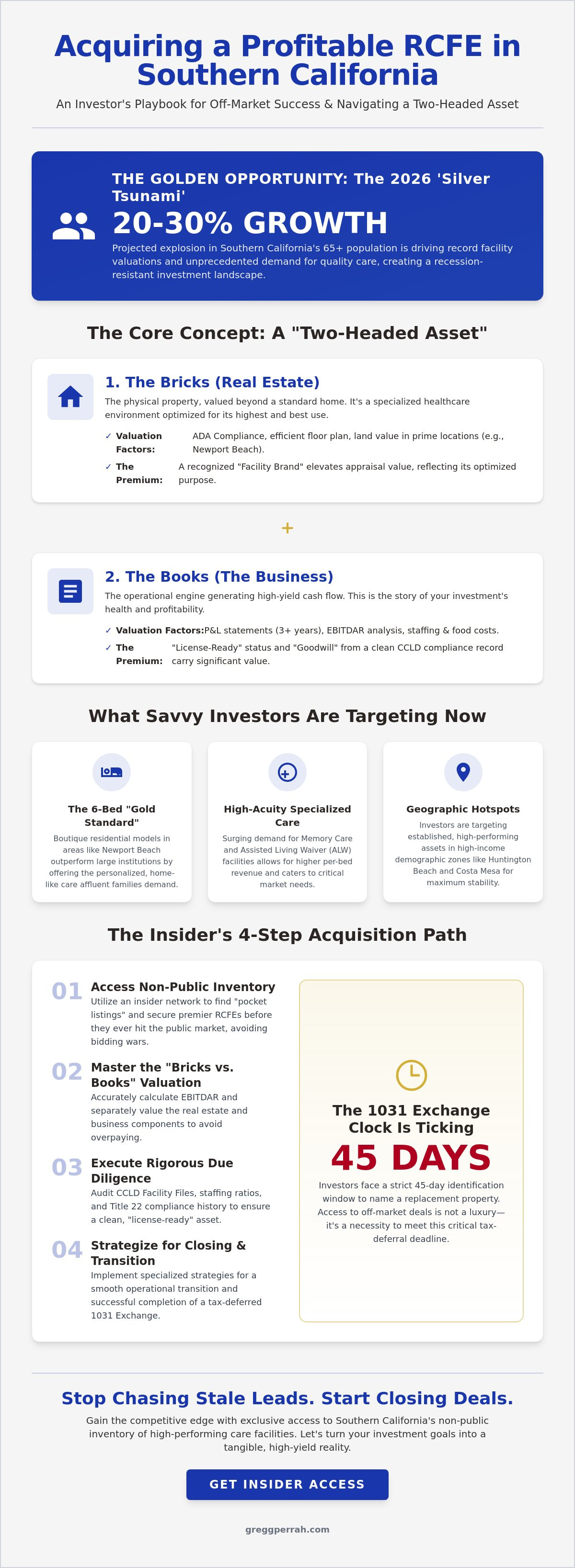
Why settle for 4% cap rates in multi-family real estate? The 2026 'Silver Tsunami' has arrived. In Southern California, the 65+ population is exploding, with a projected 20-30% growth over the next decade. This isn't just a trend; it's a permanent shift in the investment landscape. A Residential Care Facility for the Elderly (RCFE) represents a sophisticated, two-headed asset. When you evaluate an rcfe for sale, you're looking at a recession-resistant business tied to a valuable real estate footprint.
The current market is shifting toward high-acuity care. We're seeing a massive surge in demand for Memory Care and Assisted Living Waiver (ALW) certified facilities. As of May 2026, there are over 7,800 licensed RCFEs in California, yet supply remains critically constrained. This scarcity drives value. Investors who understand the supply-demand gap in Orange County are positioning themselves for long-term stability and superior cash flow.
RCFE vs. Traditional Assisted Living
Stop thinking about massive, cold institutions. The 6-bed residential model is the gold standard for many Orange County investors. By understanding residential care models, you'll see why boutique facilities in Newport Beach and Costa Mesa are outperforming large-scale competitors. These properties operate under strict California Title 22 regulations, offering a level of intimacy and personalized care that institutional giants simply cannot match. Families want a home, not a hospital. Boutique care is winning because it offers the privacy and attention that affluent Southern California families demand.
Market Trends in Southern California
What's driving profitability right now? High-performing facilities are focusing on specialized care to maximize revenue per bed. Consider these key factors:
- Occupancy Benchmarks: Top-tier facilities in 2026 are maintaining near-full occupancy due to the constrained supply of licensed beds.
- Specialized Revenue: Updated dementia care regulations from January 1, 2025, have paved the way for higher per-bed revenue through person-centered care models.
- Geographic Hotspots: Huntington Beach and Costa Mesa remain prime targets for investors seeking established, high-performing assets in high-income demographics.
The market is consolidating. Private equity firms are hunting for value-add opportunities where they can implement better management or specialized programs. If you want to secure a high-performing rcfe for sale, you need to act before these institutional players lock up the non-public inventory. The demand is relentless. Do you have the insider access to meet it?
The Two-Headed Asset: Business Value vs. Real Estate Value
Why do so many buyers struggle to close? They treat an rcfe for sale like a standard residential flip. This is a critical error. Acquiring a care facility means you are buying two distinct assets: the "bricks" and the "books." The real estate provides the foundation, but the operating business generates the high-yield cash flow. You must value them separately to ensure you aren't overpaying for the physical structure while underestimating the intrinsic value of the license and resident census.
Valuing the Real Estate (The Bricks)
The physical property isn't just a house; it's a specialized healthcare environment. When assessing the "bricks," you have to look beyond curb appeal. Are the hallways wide enough for ADA compliance? Does the floor plan support efficient staffing? In high-end markets, you should compare these properties to Newport Beach real estate trends to understand the baseline land value. However, a facility with a recognized local brand often commands a premium. This "Facility Brand" can elevate the appraisal value of the real estate because the property is already optimized for its highest and best use.
Valuing the Business (The Books)
The "books" tell the real story of your investment. You need to analyze at least three years of P&L statements. Focus on staffing costs and food expenses, as these are your primary variable overheads. We look at EBITDAR to determine the true operational health. A "License-Ready" turnkey rcfe for sale carries a significant premium. This value reflects the "Goodwill" of a facility with a clean record under California's Senior Care Licensing Program. A transferrable waitlist and a stellar reputation with local hospitals can be worth more than the physical walls themselves.
Financing these deals requires a specialized approach. Conventional commercial mortgage rates in Southern California currently range from 5.43% to 8.84%, but lenders look at more than just interest. They underwrite based on both the real estate value and the historical cash flow. While SBA 7(a) loans are popular for their lower down payments, they come with rigorous oversight. Conventional loans might offer more flexibility for experienced operators with strong balance sheets. Don't leave your capital strategy to chance. If you're unsure how to split your offer between asset classes, it's time to get a professional investment property analysis to protect your margins.
Due Diligence Checklist: Avoiding Regulatory Nightmares
Don't let a low price tag blind you to a regulatory disaster. When you find an rcfe for sale that looks too good to be true, it usually is. In the high-stakes world of Southern California care facilities, your profit margin is only as strong as your compliance record. One major citation from the Community Care Licensing Division (CCLD) can freeze your admissions or, worse, revoke your license entirely. You aren't just buying real estate; you're inheriting a reputation and a history of state oversight. Success requires a ruthless, multi-step audit before you ever sign the closing documents.
Your first move is a deep dive into the official record. You must request the full "Facility File" from the California Senior Care Licensing Program. This isn't a suggestion; it's a requirement for any serious investor. This file contains every inspection report, complaint, and citation issued to the property. Beyond the paperwork, you must verify the physical safety of the building. Fire clearance is non-negotiable. If the facility hasn't been updated to meet the 2026 California fire and life safety codes, you're looking at a massive capital expenditure right out of the gate. Finally, audit the resident contracts. Are the rate increase histories consistent with local market inflation? If the current owner hasn't raised rates in three years, you're buying an underperforming asset that will require difficult conversations with families on day one.
The CCLD Facility File Audit
Analyze the last 24 months of activity with extreme scrutiny. Are there recurring Type A citations? These represent immediate risks to resident health and safety and are major red flags. Type B citations are less severe but show a pattern of operational sloppiness. Check the Administrator's certification status immediately. If their credentials have expired or if they haven't completed the mandatory 80-hour Initial Certification Training Program, you lack the legal leadership required to operate. Ensure the "Plan of Operation" isn't just a dusty binder; it must be a living document that matches current staffing ratios and the updated 2025 dementia care standards.
Operational Integrity Check
Staffing turnover is the most reliable indicator of a healthy RCFE. High churn rates signal poor management and impending regulatory trouble. When you evaluate assisted living for sale near me, look for facilities where the core care team has been in place for years. This stability translates to resident satisfaction and higher occupancy. Don't forget the "off-the-books" due diligence. Talk to families and local hospice partners. Their feedback reveals the true quality of care that a state inspector might miss during a scheduled visit. Is the facility a trusted name in Huntington Beach or Newport Beach? Reputation is an asset you can't easily rebuild once it's tarnished.
Acquiring a facility with a clean compliance history is the only way to ensure immediate cash flow. Do you know how to spot a hidden liability in a staffing schedule? Are you prepared to challenge a questionable resident contract? Don't gamble with your capital. Ensure every box is checked so your rcfe for sale remains a high-performing investment rather than a legal burden.
Accessing the 'Non-Public' Inventory: Why You Need an Insider
Searching for an rcfe for sale on a public portal is the fastest way to find a picked-over asset. The most profitable, high-occupancy facilities in Southern California never hit the open market. This is the Privacy Paradox. If an owner places a "For Sale" sign in the front yard, they risk immediate resident flight and staff mass-exits. Public listings signal instability. To protect the valuation of a multi-million dollar business, top-tier operators only work through established, private networks. If you're only looking at stale data on global platforms, you're missing the real opportunities.
In the Orange County care facility market, "pocket listings" are the standard, not the exception. You need a luxury real estate agent who understands that these aren't just houses; they are sensitive operating environments. My 29-year network in this regional landscape gives you direct access to inventory before it ever reaches the MLS. I'm talking about facilities with clean compliance histories and established waitlists that are traded quietly between vetted investors. This insider access is the proprietary advantage that separates serious operators from casual lookers.
Protecting Resident Continuity
Confidentiality is the currency of a successful RCFE transaction. We use a rigorous Confidentiality Agreement (NDA) process to ensure that only serious, vetted investors see the "books" we discussed in the previous section. This discretion preserves the facility's valuation during the transition. When the staff and residents remain unaware of the sale until the deal is finalized, you inherit a stable, cash-flowing asset rather than a chaotic environment. Off-market deals are the only way to ensure a seamless handover of care standards and operational integrity.
Strategic Networking in SoCal
Local tenure in Newport Beach and Huntington Beach isn't just a badge of honor; it's a functional tool for deal-making. Sellers in these high-income zones prefer buyers who come through a trusted broker's network. They want to know the buyer is qualified and understands the nuances of Title 22. For example, we've successfully facilitated the sale of premier 6-bed RCFEs in Costa Mesa that never touched a public site. The seller avoided the stress of public tours, and the buyer secured a high-performing asset without a bidding war. This is how high-stakes transactions are won in 2026.
Are you ready to see the inventory that your competitors can't find? Don't wait for a public listing that will already be overpriced by the time you see it. Contact me today to access my exclusive off-market RCFE network and secure your next investment with total confidence.
Closing the Deal: 1031 Exchanges and Transition Strategies
Don't let the IRS take a bite out of your hard-earned equity. If you're divesting from a traditional asset, a 1031 exchange is your most powerful tool to defer capital gains and build a high-yield care portfolio. However, the clock is your biggest enemy. You have exactly 45 days to identify a replacement property and 180 days to close. In a market where high-performing assets are held privately, finding a compliant rcfe for sale within that window is nearly impossible without an insider. You need a strategy that aligns your financial exit with a surgical entry into the care sector.
Closing an RCFE deal isn't like a standard residential closing. You're navigating a Change of Ownership (CHOW) process that requires precision. The license itself does not automatically transfer to you at the close of escrow. You'll need to submit a comprehensive application to the CCLD, pay the required fees, such as the $1,486 application fee for a 7 to 15-bed facility, and complete the mandatory $50 orientation. Your purchase agreement must include a "License Contingency" clause. This protects your capital by ensuring the deal only finalizes if the state approves your ability to operate. I've spent nearly three decades refining these contracts to protect my clients from regulatory limbo.
The 1031 Exchange Timeline
Success requires perfect synchronization. If you are selling a commercial property for sale Costa Mesa, you must have your RCFE targets vetted before you even open escrow on your relinquished asset. To avoid the "Boot," the real estate value of your new facility must match or exceed the value of the property you sold. Remember, a 1031 exchange only applies to the "bricks," not the business "goodwill." You need a Qualified Intermediary who understands how to bifurcate these values. We work with specialists who ensure your tax-deferred status remains bulletproof while you transition into a more profitable asset class.
The Gregg Perrah Advantage
Why gamble with a general practitioner when you can leverage 29 years of localized tenure? I don't just find listings; I create opportunities. My team provides the investment property analysis you need to verify EBITDAR and occupancy history before you ever make an offer. We bridge the gap between complex state mandates and your financial goals. We are the centralized resource for Southern California care facility investments. The 2026 market moves fast, and the best facilities are gone in days. Are you ready to execute? Contact Gregg Perrah for an exclusive RCFE valuation and inventory list.
Securing a premier rcfe for sale is about more than just a transaction; it's about securing your financial legacy in a recession-proof industry. Don't let the complexities of Title 22 or 1031 deadlines stall your progress. Let's put my network to work for you and close your next deal with the confidence that only decades of experience can provide.
Secure Your High-Yield Care Facility Today
The 2026 senior care market waits for no one. You now have the strategic blueprint to navigate the "bricks and books" valuation model and the rigorous CCLD audit process. Success in this specialized sector isn't about finding just any rcfe for sale; it's about securing the right one before your competition even knows it exists. You need a dedicated partner who can bridge the gap between complex Title 22 regulations and your aggressive financial goals. Why gamble with your capital when you can rely on a veteran who knows the Southern California landscape inside and out?
Leverage 29+ years of Southern California real estate tenure and my specialized Senior Real Estate Specialist (SRES) certification. I maintain a proven track record in complex 1031 exchange facilitation to ensure your transition is seamless and tax-efficient. Stop searching the public portals for stale data. It's time to access the non-public inventory that drives real wealth and operational stability. Your next high-performing asset is ready for acquisition. Get Access to Exclusive Off-Market RCFE Listings Today. Let's build your legacy in the care industry together.
Frequently Asked Questions
Can I buy an RCFE if I don't have a California Administrator's License?
Yes, you can own the business and the real estate without being a certified Administrator. However, California law requires you to employ a certified individual to oversee the daily operations of the facility. Many investors choose to handle the financial and strategic management while hiring a professional to maintain compliance with Title 22 regulations.
What is the typical down payment required for an RCFE for sale in Orange County?
Expect to provide a down payment between 10% and 25% depending on your chosen loan product. SBA 7(a) loans are popular for an rcfe for sale because they often allow for 10% down. If you opt for conventional commercial financing, lenders typically require a 20% to 25% equity stake to offset the risks associated with service-based assets.
How long does the Change of Ownership (CHOW) process take for a new RCFE owner?
The CHOW process generally takes between 90 and 120 days from the date you submit your application to the Community Care Licensing Division. This timeline includes the mandatory background checks, LiveScan fingerprinting, and a thorough review of your Plan of Operation. Any outstanding citations on the facility can extend this period, so ensure your due diligence is complete before filing.
What is the difference between an RCFE and an Adult Family Home (AFH) in California?
In California, an RCFE is specifically licensed for residents aged 60 and older who require varying levels of care. While the term "Adult Family Home" is common in other states, California uses categories like Small Family Homes for younger adults with developmental disabilities. RCFEs follow strict Title 22 standards focused on elderly care, dementia support, and hospice waivers.
Are RCFE businesses eligible for SBA financing?
Yes, RCFEs are prime candidates for SBA 7(a) and 504 loan programs. These loans are attractive because they allow you to finance the business acquisition and the real estate under one umbrella. Lenders value the consistent cash flow and the high demand for senior housing, making it easier to secure competitive terms for a qualified rcfe for sale.
Why are so many RCFEs for sale listed as 'confidential' or 'off-market'?
Confidentiality is the only way to prevent resident "flight" and staff anxiety during a transition. If families see a public "For Sale" sign, they often panic and move their loved ones to a different facility. We keep these listings non-public to protect the business's census, staffing stability, and overall valuation until the deal is finalized.
Can I live in the RCFE facility I purchase?
Yes, you can live on-site as an owner-operator, provided your living quarters are separate from the licensed resident rooms. You must ensure your presence doesn't reduce the required square footage for resident care or violate any local zoning laws. This is a common strategy in 6-bed boutique facilities where the owner provides direct oversight.
What are the common pitfalls when buying an existing care home business?
The biggest pitfalls are inheriting undisclosed CCLD citations and failing to verify the "Facility Brand" reputation. Many buyers skip the deep-dive audit of the Facility File and end up with a business on the verge of license revocation. Always verify that the fire clearance is current and that the resident contracts allow for the rate increases necessary to maintain profitability.