

That unpermitted coastal remodel or custom guest house isn't just a secret; it's a potential misdemeanor under Newport Beach's 2026 building codes. Are you worried that city inspectors will derail your escrow or that a savvy buyer will use your "as-is" property to demand a massive price cut? You're right to be concerned. In today's market, selling a home with unpermitted work in Newport Beach requires more than just a standard listing. It demands a strategic valuation and disclosure plan that guards you against daily fines and the double-fee penalties now standard for work started without a permit.
We understand the anxiety of facing the updated Transfer Disclosure Statement (TDS) requirements. From disclosing nicotine residue to identifying every gas appliance and flagging AI-enhanced listing photos, the 2026 legal landscape is a minefield for the unprepared. This article reveals the exact strategy to navigate these hurdles without sacrificing your luxury valuation. You'll discover how to handle retroactive permitting, protect yourself from post-sale litigation, and position your property to attract the right buyers who see the value, not the violations. Let's turn your permit issues into a manageable roadmap for a high-value closing.
Key Takeaways
- Identify why 2026 Newport Beach codes classify unpermitted modifications as misdemeanors and how to sidestep the automatic double-fee penalty.
- Discover why unpermitted square footage often carries a zero-dollar valuation in bank appraisals and how to prevent buyers from using it as a negotiation hammer.
- Master the updated 2026 California TDS requirements to ensure your disclosure acts as a legal shield when selling a home with unpermitted work in Newport Beach.
- Evaluate the "Clean Slate" versus "Strategic Disclosure" paths to determine which strategy protects your equity and minimizes your time on market.
- Gain the advantage of 29 years of local expertise to connect with a specialized network of luxury buyers who understand complex property profiles.
What Qualifies as Unpermitted Work in Newport Beach?
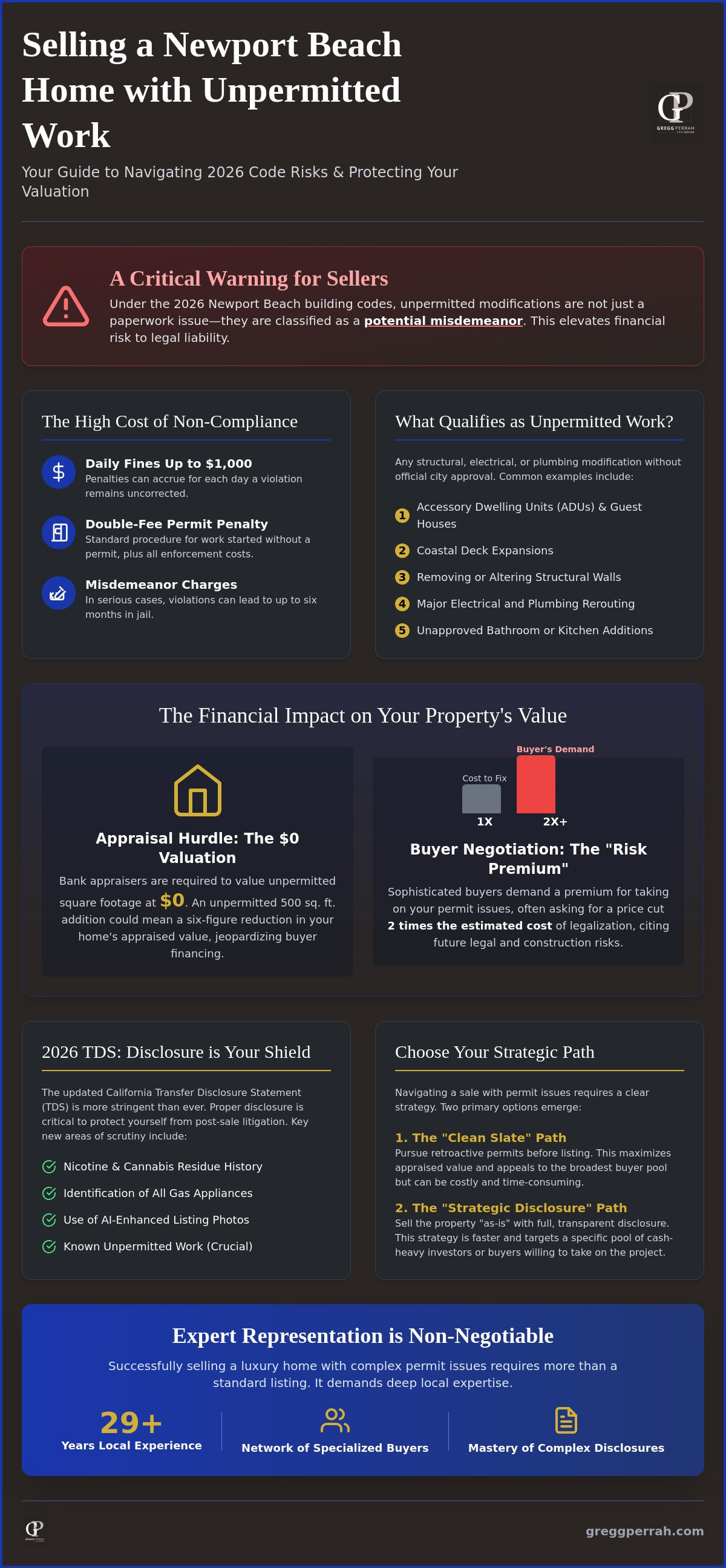
Stop guessing and start knowing. What exactly is unpermitted work? It is any structural, electrical, or plumbing modification performed without official City of Newport Beach approval. Many homeowners assume minor interior changes fly under the radar. They don't. What Qualifies as Unpermitted Work is defined by the 2026 municipal code as any project that bypasses official oversight. In our city, this isn't just a clerical oversight; it's a misdemeanor. You could face fines up to $1,000 per day or even six months in jail. Why take that risk when 367 permits were filed in the city just this month? Our local codes are notoriously stricter than Irvine or Costa Mesa. You need a strategy that acknowledges this reality before your first showing.
The Newport Beach Community Development Department maintains meticulous historical property records. They know what your house looked like in 1970. On the Newport Peninsula, we deal with "Legacy Issues" daily. These are decades-old modifications passed from owner to owner. Don't assume "grandfathered in" means "legal." If the records don't show a permit, the city won't care how long the improvement has been there. When you're selling a home with unpermitted work in Newport Beach, these historical discrepancies become immediate deal-killers during the due diligence phase.
Common Unpermitted Projects in Coastal Estates
High-end remodels often skip the paperwork to save time. We see it constantly with Accessory Dwelling Units (ADUs) and guest houses built before the recent legislative shifts. Are you selling a home with unpermitted work in Newport Beach that includes a luxury deck expansion? If you're in the coastal zone, you're dealing with the California Coastal Commission and FEMA regulations. Even removing a single structural wall to create an "open concept" layout requires engineering sign-offs. Without them, your luxury valuation is on thin ice. Bank appraisers will see the missing paperwork and potentially slash your square footage valuation to zero.
The Risk of Code Enforcement in Newport Beach
How does the city find out? Sometimes it's a disgruntled neighbor reporting your short-term rental. Other times, it's a sale-triggered inspection. If you're in zip codes 92660 or 92663, the scrutiny is intense. Newport Beach now links short-term lodging permits to building compliance. One unpermitted bathroom can get your lucrative rental permit revoked instantly. If enforcement catches you, expect a "Stop Work" order and a penalty of double the original permit fee. All enforcement costs and attorney fees? Those are on your tab too. Don't wait for a city inspector to knock. Secure your equity by addressing these issues proactively with seasoned guidance.
The Financial Impact: How Permit Issues Affect Newport Beach Valuations
Equity is earned in the details, but it's lost in the gaps. When you're selling a home with unpermitted work in Newport Beach, the bank's appraiser is often your first major hurdle. Under current lending guidelines, unpermitted square footage is almost universally valued at $0. Imagine losing the valuation of a 500-square-foot master suite extension because a permit wasn't finalized in 2015. That isn't just a clerical error; it's a six-figure hit to your bottom line. Local bank appraisers are required to distinguish between "livable space" and "legally permitted space." If the city records don't match the physical structure, the lender will likely refuse to include that space in the loan-to-value calculation.
Buyer psychology in the luxury market is equally unforgiving. Newport Beach buyers are sophisticated. When they discover permit gaps, they don't just ask for a credit covering the permit fee. They demand a "risk premium," often calculated at two times the estimated repair or legalization cost. They aren't just buying a house; they're buying your potential legal headaches. This friction frequently disqualifies properties from jumbo loan financing, which is the lifeblood of our coastal market. If a property can't be appraised for the full purchase price, the deal usually collapses unless you pivot to a cash-heavy buyer pool. We specialize in Investment Property Analysis to help you identify these valuation traps before you hit the open market.
Appraisal Hurdles for High-End Coastal Homes
In neighborhoods like Corona del Mar, "bonus rooms" and third-story lofts are common targets for scrutiny. An appraiser may note the high-end finishes but ultimately list the room as "non-conforming" on the report. This creates a massive disconnect between your asking price and what a buyer's bank will actually fund. Beyond the appraisal, title insurance companies are increasingly adding specific exceptions for unpermitted structures. This means the buyer's title policy won't cover future losses related to those structures, further spooking conservative luxury investors. Complying with California Disclosure Laws is the only way to mitigate this risk, but it must be done with surgical precision to protect your price point.
The Cost of "After-the-Fact" Permits
Attempting to fix these issues during escrow is a recipe for disaster. Newport Beach often requires "Destructive Testing" for retroactive approvals. This means a city inspector might order you to tear down expensive custom drywall just to verify the gauge of the wiring or the placement of plumbing vents. You'll also face a $65 per hour re-inspection fee for every follow-up visit required to clear the violation. Under the 2026 fee schedule, Newport Beach assesses a penalty of double the original permit fee for any work started without city authorization. Don't let a lack of paperwork turn your coastal asset into a liability.
California Disclosure Laws: Navigating the TDS and Legal Liability
Think your "As-Is" clause is a get-out-of-jail-free card? Think again. In California, silence is expensive. The Transfer Disclosure Statement (TDS) is your primary legal shield, but only if it's executed with surgical precision. If you're selling a home with unpermitted work in Newport Beach, this document is where you stop a future lawsuit before it starts. The 2026 updates to the TDS are more granular than ever. As of January 1, 2026, you must disclose tobacco residue, the presence of every gas-powered appliance, and even the use of AI-generated listing photos. Failing to check the right box regarding structural modifications doesn't just jeopardize the sale; it invites a misdemeanor charge. Navigating the TDS with a veteran's eye is the only way to ensure your closing is final and your equity is protected.
Senior sellers or those managing family estates face unique risks when property records are incomplete. This is why Gregg Perrah’s designation as a Senior Real Estate Specialist is critical. We don't just list homes; we insulate our clients from the liability traps that generalist agents often miss. Along with the TDS, we analyze the Natural Hazard Disclosure (NHD) to see how coastal hazards intersect with your specific property. If an unpermitted seawall or deck expansion sits in a Special Flood Hazard Area, your disclosure strategy must account for FEMA and Coastal Commission oversight. Don't leave your financial future to chance.
The Consequences of Non-Disclosure
Newport Beach buyers have deep pockets and aggressive legal teams. If they discover unpermitted wiring or a non-compliant guest house after the keys are handed over, they will sue. Under California law, the "Three-Year Rule" allows buyers to sue for fraud or misrepresentation up to three years after they discover the issue. That’s a long time to keep your checkbook open for a property you no longer own. Documenting unpermitted work correctly means providing the buyer with every scrap of history you have. We help you frame these disclosures so they provide protection without scaring off qualified offers.
The "As-Is" Addendum in the Newport Beach Market
Many sellers believe the "As-Is" addendum in the California Residential Purchase Agreement (RPA) lets them off the hook for permit gaps. It doesn't. While the RPA states the property is sold in its present condition, it explicitly requires the seller to disclose all known material facts. Luxury buyers still expect a "clean" permit history or a massive price concession to compensate for the risk. We use the Seller Property Questionnaire (SPQ) strategically to supplement the TDS. This creates a comprehensive paper trail that proves you were transparent. A full disclosure today prevents a massive settlement tomorrow.
Strategic Options: Three Paths to a Successful Newport Beach Sale
Stop letting permit anxiety paralyze your equity. You have three distinct paths to a successful closing, and the right choice depends on your timeline and risk tolerance. In the 2026 market, the highest net proceeds don't always come from the highest offer. They come from the offer that actually closes without a lawsuit. Whether you choose to fix the records, disclose the gaps, or sell off-market, you need a strategy that accounts for the aggressive scrutiny of Newport Beach inspectors and savvy coastal buyers.
Path 1: The Retroactive Permit. This is the "Clean Slate" approach. If your modifications meet current 2026 setbacks and safety standards, you can apply for after-the-fact approval. It's often the best way to reclaim lost valuation. Path 2: The Strategic Disclosure. This is the "As-Is" open market play. You list the property with a comprehensive disclosure package, targeting buyers who have the capital and patience to handle the city themselves. Path 3: The Off-Market Direct Sale. This is the "Privacy and Speed" approach. We use our exclusive network to find "permit-friendly" luxury investors who buy for the land value or the renovation potential, bypassing the public Newport Beach real estate listings entirely.
When to Pursue Retroactive Permits
Does your unpermitted work qualify for a quick fix? If you have a guest house or ADU built with quality materials, the ROI of legalizing it is massive. Newport Beach ADU plan check fees for 2026 range from $850 to $1,700. Compare that to the $700 to $1,000 per square foot that ultra-luxury homes command in our market. We work with local architects who specialize in certifying existing structures to satisfy the Community Development Department. If the bones are good, legalizing the space before you hit the market can add hundreds of thousands to your final sale price.
Selling to Cash Investors vs. Traditional Buyers
Traditional buyers rely on bank financing. As we've established, banks hate permit gaps. If you need a fast exit, a cash investor is your best ally, but you must be careful. The Newport market is currently flooded with "Solar Cowboys"—predatory, out-of-town investors who cast wide nets but fail to perform. You need a legitimate Newport Beach developer who understands coastal zone complexities. We vet every cash offer to ensure the proof of funds is real and the closing date is firm. Ready to see what your home is worth in its current condition? Get a professional investment property analysis today to determine your best exit strategy.
Why Expert Representation is Non-Negotiable for Permit Issues
Why trust a generalist with your coastal equity? When selling a home with unpermitted work in Newport Beach, the stakes are too high for trial and error. You need the power of 29 years of local tenure. We don't just list properties; we deploy a sophisticated infrastructure designed to protect sellers from the specific pitfalls of the 2026 market. Our deep roots in the community provide access to a specialized network of "permit-friendly" luxury buyers and non-public inventory opportunities that general practitioners simply can't reach. This isn't just about marketing; it's about high-level negotiation and institutional knowledge.
Complex property profiles require more than a standard sales approach. Are you dealing with a residential care facility or a commercial asset with permit gaps? Our expertise extends to the intersection of residential compliance and specialized assets like an RCFE for sale. We understand how municipal code violations impact business licensing and investment property analysis. By utilizing our comprehensive Newport Beach real estate guide, you gain an insider's perspective on how to frame your property’s potential while insulating yourself from post-sale litigation.
The Gregg Perrah Advantage: Proactive Problem Solving
We act as your centralized resource center. Our team initiates pre-listing inspections to catch permit discrepancies before a buyer’s appraiser does. We don't just point out problems; we provide the solution by connecting you with a vetted network of Newport Beach contractors and permit expediters. Gregg’s tireless, "always-on" veteran energy ensures that even the most volatile high-stakes transactions remain on track when city inspectors or nervous lenders threaten to derail a closing. We handle the friction so you can focus on your next move.
Maximizing Equity in 92660, 92663, and Beyond
Success in zip codes like 92660 and 92663 requires a surgical marketing strategy. Global branding might look good on a sign, but it doesn't navigate the Newport Beach Building Division's 2026 fee schedule or the nuances of the Coastal Commission. We highlight your property's unique value while maintaining total legal transparency. This proactive stance builds trust with qualified buyers and keeps your price point firm. Don't leave your net proceeds to chance. Contact Gregg Perrah today for a confidential permit audit and property valuation.
Secure Your Coastal Equity Today
Don't let permit gaps paralyze your financial future. You now have the roadmap to navigate the 2026 building codes and the updated TDS requirements without sacrificing your luxury valuation. Whether you choose to pursue retroactive permits or a targeted off-market sale, transparency and local tenure are your best defenses against post-sale litigation. Success in selling a home with unpermitted work in Newport Beach comes down to the expertise of the negotiator in your corner.
With over 29 years of local real estate experience and a Senior Real Estate Specialist (SRES) certification, we provide the specialized guidance required for high-stakes transactions, including complex 1031 exchanges and RCFE sales. We transform your property's potential liabilities into a clear, manageable path toward a successful closing. Are you ready to see how your property stacks up in the current market? Get a Professional Valuation of Your Newport Beach Home today. Your successful exit starts with a confidential audit and the right veteran strategy.
Frequently Asked Questions
Can I get a permit for work that was done years ago in Newport Beach?
Yes, you can obtain a retroactive permit through the city's "after-the-fact" process. The Building Division requires the work to meet current 2026 safety and structural codes, even if it was built decades ago. You'll need to submit detailed plans and likely undergo inspections that may require exposing hidden electrical or plumbing components to verify compliance.
Will the City of Newport Beach make me tear down unpermitted work if I disclose it?
Not always, but it's a possibility if the work cannot be brought up to code. The city's primary goal is safety and compliance with the 2026 California Building Code. If a structure is found to be fundamentally unsafe or violates zoning setbacks, they may issue a "Stop Work" order or require removal. Most homeowners avoid this by working with a professional expediter to legalize the space before enforcement kicks in.
How much does unpermitted work typically devalue a Newport Beach home?
Unpermitted square footage is frequently valued at zero dollars by bank appraisers, which can slash your listing's potential by hundreds of thousands. Beyond the appraisal, luxury buyers in the 92660 and 92663 zip codes often demand credits equal to twice the estimated cost of permit legalization. This "risk premium" accounts for the uncertainty and time required to deal with city hall.
Can a buyer back out of a contract if they find unpermitted work?
Yes, a buyer can typically cancel the contract without penalty if they are within their inspection or due diligence contingency period. Discovering unpermitted modifications is considered a "material fact" that affects the property's value and desirability. If you didn't disclose the issues upfront, the buyer has a strong legal standing to walk away or renegotiate for a significantly lower price.
Is it illegal to sell a house with unpermitted work in California?
It is perfectly legal to sell the property, but it is illegal to hide the permit status from the buyer. When selling a home with unpermitted work in Newport Beach, your legal obligation is total transparency through the Transfer Disclosure Statement (TDS). As long as you disclose the known issues, you aren't breaking the law, though you may face a more limited pool of traditional buyers.
What is the "after-the-fact" permit process like at Newport Beach City Hall?
The process is rigorous and expensive. You'll start by paying a penalty fee, which is double the original permit cost under the 2026 fee schedule. From there, you must submit architectural plans and schedule inspections. Expect to pay $65 per hour for any re-inspections required to clear the file. It's a high-stakes paper trail that requires professional management to avoid endless delays.
Does homeowners insurance cover issues caused by unpermitted work?
Most insurance carriers will deny claims for damages resulting from unpermitted work. If an unpermitted electrical panel causes a fire or a non-compliant plumbing line leads to a flood, you're likely on the hook for the entire cost. This lack of coverage is a major reason why sophisticated Newport Beach buyers and their lenders are so cautious about permit gaps.
How do I find out if my Newport Beach home has unpermitted work before I sell?
Check your property records through the City of Newport Beach online permit portal or visit the Community Development Department in person. Compare the city's blueprint and permit history to the current physical structure of your home. If you see a third-story loft or a converted garage that isn't on the official record, you have a permit issue that needs a strategy before you list.