

Did you know that failing to claim your Prop 19 exclusion correctly could cost your heirs over $1 million in taxable value? You've spent decades building equity in a market with an $84.4 billion assessed value base, yet one wrong move during a title transfer can trigger a massive property tax hike. Selling a home in a trust Newport Beach is no longer a simple transaction. It's a high-stakes battle against California's aggressive tax reassessments and complex beneficiary expectations.
You want a sale that honors the trust's terms and maximizes the final price for the heirs. We agree that the process feels like a minefield of legal jargon and financial risk. This guide is your central resource for protecting your coastal assets. You'll learn how to leverage the $1,044,586 parent-child exclusion, manage the 2026 Medi-Cal asset limits, and track the "Repeal the Death Tax" initiative. We'll show you how to move from confusion to a seamless, high-value closing that preserves your family's legacy.
Key Takeaways
- Learn how the Successor Trustee must verify the "Power of Sale" clause to prevent legal delays during the transaction.
- Master our 5-step checklist for selling a home in a trust Newport Beach to satisfy strict California title company requirements and high-value coastal regulations.
- Discover why trust sales offer unique disclosure exemptions and how to fulfill your fiduciary duty by securing the highest market price.
- Safeguard your inheritance from Prop 19 tax triggers by understanding the 2026 residency requirements for parent-child property transfers.
- Leverage 26 years of seasoned authority to manage complex family dynamics while maximizing the equity of your Newport Beach estate.
What Does Selling a Home in a Trust in Newport Beach Entail?
Are you holding the keys to a high-value estate but feel buried under legal paperwork? Selling a home in a trust Newport Beach isn't your standard residential transaction. It means the legal title to the property is held by a trust entity rather than an individual. To understand the foundation of this process, you must first ask: What is a Trust? Essentially, it is a fiduciary arrangement where a third party holds assets on behalf of a beneficiary. In the context of Newport Beach real estate, this adds layers of complexity that require a specialized approach.
If you're the Successor Trustee, you're now the primary decision-maker. You don't just sell the house; you act as a fiduciary. This means you're legally bound to act in the best interest of the beneficiaries. Selling while the grantor is alive is often simpler because they retain control. Once they pass, the trust becomes a fixed roadmap you must follow to the letter. Don't risk a lawsuit from disgruntled heirs. Get the right guidance early. Newport Beach trust sales are high-stakes because of our unique coastal land values and complicated tax bases. Every decision you make is under a microscope.
Revocable vs. Irrevocable Trusts in Real Estate
A Revocable Living Trust allows the owner to maintain full control and even dissolve the trust if they choose. Authority shifts instantly when a trust becomes irrevocable, usually upon the grantor's death. This is where the Successor Trustee takes the wheel. You'll need a Certification of Trust, which is a concise legal document that proves your authority to sell the property without exposing every private detail of the full trust agreement to title companies or buyers.
Why Newport Beach Market Dynamics Matter
Newport Beach isn't a typical market. With a total assessed property value of $84.4 billion for the 2025 to 2026 fiscal year, the financial stakes are massive. Liquidation timelines for coastal inventory move fast; you can't afford to let a property sit while you figure out the legalities. You need a veteran who understands the nuances of exclusive enclaves like Pelican Crest. Many high-profile trustees prefer privacy, making "off-market" secrets vital for a discreet and successful sale. Don't settle for a general practitioner when you're managing a legacy asset. When selling a home in a trust Newport Beach, you need a central resource center that handles the heavy lifting while you focus on your family.
The Trustee’s Checklist: 5 Steps to Sell a Trust Property
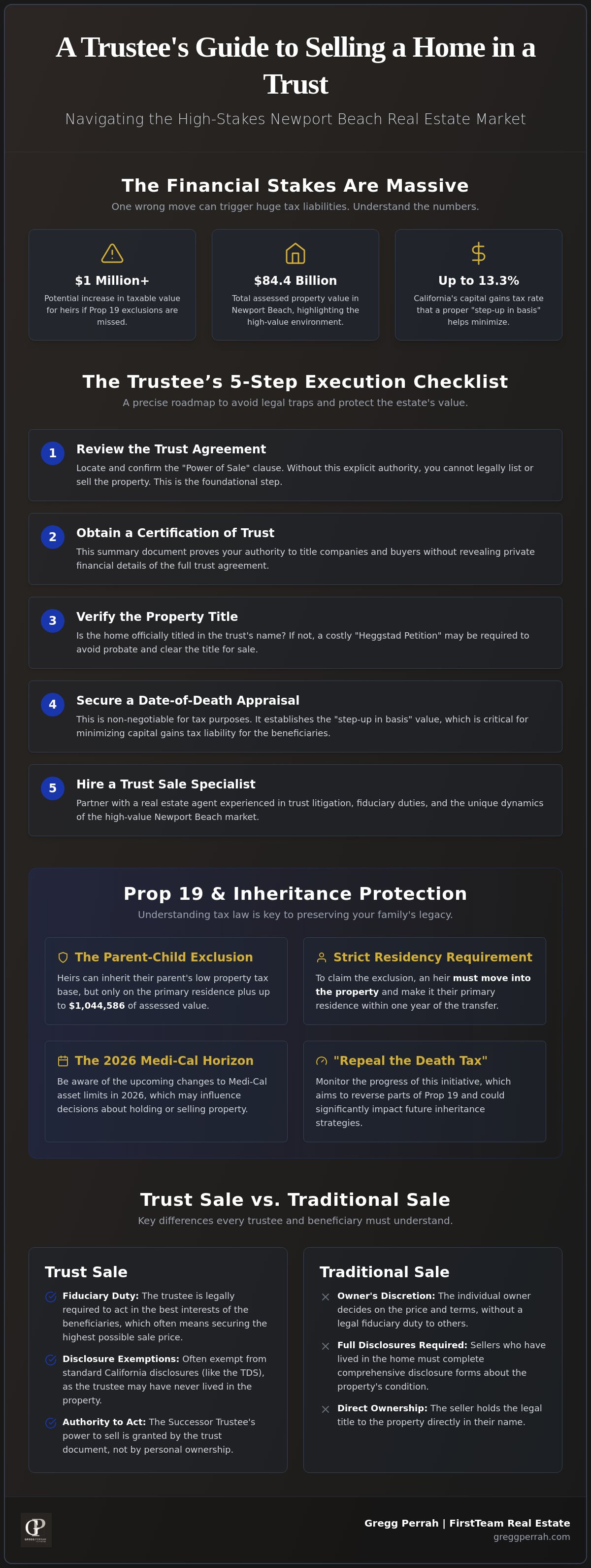
Ready to move? You need a roadmap that leaves zero room for error. Selling a home in a trust Newport Beach requires more than just a "For Sale" sign. It demands a rigorous, five-step verification process to protect your fiduciary standing and the heirs' equity. Don't guess. Execute these steps with precision to avoid the legal traps that snare unprepared trustees.
- Step 1: Review the Trust Agreement. You must confirm the "Power of Sale" clause exists. Without this explicit authority, you cannot legally transfer the property to a buyer.
- Step 2: Obtain a Certification of Trust. California title companies require this document. It summarizes your authority without exposing the private financial details of the full trust.
- Step 3: Verify the Title. Is the property actually in the trust? You'd be surprised how often high-value coastal estates are still held in the grantor's individual name, requiring a costly "Heggstad Petition" to fix.
- Step 4: Secure a Date-of-Death Appraisal. This is non-negotiable. It establishes the "step-up in basis," which is vital for minimizing California’s capital gains taxes that can reach 13.3%.
- Step 5: Hire an Expert. Don't settle for a generalist. You need a luxury real estate agent who understands trust litigation and the specific demands of the Newport market.
Clearing Title and Legal Hurdles
Newport Beach properties often carry decades of history. Red flags like outdated trust names or missing amendments can stall a $5 million closing in seconds. You must file an Affidavit of Death of Trustee to update the public record and signal to buyers that you have the legal right to sign the deed. We coordinate directly with trust attorneys to ensure these hurdles are cleared before the first showing. If you're feeling overwhelmed by the paperwork, you can request a professional asset assessment to get organized.
Valuation Strategies for Trust Assets
A standard Comparative Market Analysis (CMA) isn't enough to satisfy your fiduciary duties. You need a formal appraisal to address Proposition 19 Tax Implications. For transfers between February 2025 and February 2027, the exclusion limit for parent-child transfers is exactly $1,044,586 above the factored base year value. We use specialized investment property analysis to identify hidden value in trust-held land. This ensures you meet your legal obligation to seek the "highest and best" price while still moving at the speed the beneficiaries expect.
Trust Sale vs. Traditional Sale: Key Differences You Must Know
Why do standard residential sales feel like a breeze while trust transactions feel like a high-stakes legal deposition? The difference lies in liability and your legal standing. Selling a home in a trust Newport Beach removes the personal emotional layer of a typical homeowner and replaces it with a strict fiduciary framework. You aren't just selling a house; you're liquidating a legal entity's asset. This shift changes everything from how you fill out paperwork to how you defend the final sale price to heirs.
The most significant technical difference is the disclosure exemption. In a traditional sale, owners must provide a Transfer Disclosure Statement (TDS). As a Successor Trustee who likely hasn't lived in the property recently, you're often exempt from this specific requirement. Don't let this give you a false sense of security. You are still legally required to disclose every material fact you actually know. If you're aware of a foundation issue or a past flood, silence is your biggest enemy. We signal a "Trust Sale" in our marketing to attract well-funded buyers who value the speed and finality these transactions offer, provided the paperwork is ironclad.
Then there is the "Fiduciary Duty" trap. In a traditional sale, you can sell to your cousin for a discount if you want. In a trust sale, you must prove you sought the highest and best price. If you don't, you leave yourself wide open to litigation from disgruntled beneficiaries. You need a paper trail that shows aggressive marketing and competitive bidding. This is where our centralized resource center approach becomes your best defense. We provide the data and the "always-on" negotiation energy required to satisfy even the most skeptical heirs.
Disclosure Requirements and Risk Mitigation
Exemption does not mean immunity. To shield yourself from future litigation, you must use professional inspections as your primary defense. We recommend a "pre-listing" inspection suite: home, termite, and sewer lateral. By providing these reports upfront, you shift the burden of discovery to the buyer. This allows for "as-is" sales in the Newport Beach luxury market without devaluing the asset. It creates transparency that protects your personal liability long after the escrow closes.
Managing Multiple Beneficiaries
Family dynamics can derail a sale faster than a bad appraisal. When multiple heirs are involved, transparency is your only path to a smooth closing. Disagreements on list price or offer acceptance are common, especially when navigating the complex Proposition 19 inheritance rules. We act as a neutral, data-driven buffer. By providing weekly high-energy updates and market evidence to all parties, we remove the emotion from the decision-making process. This ensures the negotiation stays focused on the numbers, not old family grievances.
Prop 19 and Tax Consequences: Protecting Your Inheritance
Are you prepared for the property tax bill that arrives after the funeral? In 2026, California's tax landscape is more aggressive than ever. Proposition 19 has fundamentally changed the rules for parent-child property transfers. If you are selling a home in a trust Newport Beach, you must understand that the old "automatic" tax base carryover is gone. Today, every decision you make regarding the trust's real estate assets carries a massive financial weight.
The "Residency Requirement" is the primary hurdle. To retain a parent’s lower tax base, at least one child must move into the home and make it their primary residence within exactly one year of the transfer. Even then, there are limits. For transfers occurring between February 2025 and February 2027, the exclusion limit is capped at $1,044,586 above the parent's factored base year value. In a market like Newport Beach, where home values frequently exceed this cap, heirs often face a partial reassessment that can add tens of thousands of dollars to their annual tax bill. If the trust holds a rental property instead of a primary residence, you can leverage a 1031 exchange to defer capital gains and pivot into a more profitable asset class.
Step-Up in Basis: Your Most Powerful Tax Tool
The "step-up in basis" resets the property's cost basis to the current market value upon the grantor's death, effectively erasing decades of appreciation for tax purposes. Selling immediately after the grantor passes can result in zero capital gains tax because the sale price matches the new stepped-up value. Don't make the mistake of holding trust property for years in an appreciating market. Doing so creates a new tax liability on any growth that occurs after the date of death. Speed is your ally here.
Exit Strategies for Non-Resident Heirs
What happens when the beneficiaries have no interest in moving to Newport Beach? You're faced with the "keep as rental" vs. "sell and reinvest" dilemma. Under Prop 19, keeping the home as a rental triggers a full reassessment to current market value, often destroying the property's cash flow potential. Many smart trustees are choosing to sell and transition that equity into RCFE opportunities or other high-yield, cash-flowing assets. We can help you analyze your portfolio to find the highest return on your inherited equity. Contact us today for a strategic tax-basis consultation to ensure you don't leave money on the table.
Why Gregg Perrah is the Central Resource for Trust Sales
Selling a home in a trust Newport Beach isn't a job for a part-time agent or a general practitioner. You need a veteran who has navigated every market cycle for over 26 years. Why gamble with your family's most valuable legacy asset? With over two decades of tenure in the Newport Beach and Orange County markets, we provide the seasoned authority required to manage high-value coastal equity. We don't just list homes; we function as a centralized resource center. This means we coordinate your legal, financial, and marketing teams into one high-performance engine designed to win.
Our team holds the Senior Real Estate Specialist (SRES) designation. This provides the expert downsizing guidance families need during complex transitions. Are you dealing with a high-stakes RCFE business sale or a 1031 exchange? We have a proven track record in these specialized transactions. We understand the technical language of investment and facility-based assets. We know the urgency required in a competitive market. We prioritize your fiscal clarity above all else, ensuring every beneficiary's expectation is met with data-driven results.
The Veteran Advantage in a Volatile Market
Experience is your strategic edge when the market shifts. Decades of local data inform our pricing strategies, ensuring your trust-held estate is positioned for a swift, high-value exit. Do you want access to a proprietary network? We provide the keys to non-public inventory and exclusive buyer pools that general practitioners simply can't access. Our "always-on" dedication ensures we respond immediately to the time-sensitive nature of trust liquidations. We are assertive negotiators who remain approachable and eager to help you navigate the pressure of a fiduciary role.
Ready to Evaluate Your Trust Asset?
Have you recently been named a successor trustee? Your first move is your most critical. We offer complimentary trust property valuation and investment property analysis to provide the fiscal clarity you need to move forward. Don't let family dynamics or complex title issues stall your progress. Take command of the situation with expert guidance that honors the trust's terms. Contact Gregg Perrah today for a confidential trust sale consultation and leverage the power of a 26-year veteran to maximize your results.
Secure Your Family's Coastal Legacy Today
Are you ready to move from uncertainty to a closed escrow? Selling a home in a trust Newport Beach doesn't have to be a legal minefield. You've learned how to dodge the Prop 19 tax trap by meeting strict residency deadlines and how to leverage the step-up in basis to your advantage. You now know the difference between a standard sale and your high-stakes fiduciary duty to the heirs. Don't leave these complex details to a generalist who lacks the local tenure required for high-value coastal zones.
With 26+ years of local experience and a Certified Senior Real Estate Specialist designation, we act as your centralized resource center. We specialize in Prop 19 and 1031 exchange strategies that protect your inheritance from aggressive California tax triggers. Why wait for a legal delay to derail your plans? Take the first step toward a seamless transition and maximize your equity right now. Get Your Confidential Trust Property Valuation Now. Your family's financial future is too important to leave to chance. Let's get to work and secure the results you deserve.
Frequently Asked Questions
Do I need all beneficiaries to agree before selling a house in a trust?
No, you generally don't need unanimous consent if the trust document grants you the "Power of Sale." As the Successor Trustee, you are the sole legal decision-maker for the estate. However, you still have a fiduciary duty to act in the heirs' best interests. We recommend maintaining high-energy transparency and providing regular updates to all beneficiaries to prevent potential litigation or delays during the closing process.
How long does it take to sell a home in a trust compared to a traditional sale?
Expect a similar timeline of 30 to 45 days if your legal paperwork is organized. The process only slows down if the title is still held in the grantor's individual name or if you lack a Certification of Trust. We accelerate your timeline by identifying these "red flags" early. Our centralized resource center approach ensures that legal hurdles are cleared before the property even hits the Newport Beach market.
Can a trustee sell a house to themselves or a family member?
Yes, but you must proceed with extreme caution to avoid "self-dealing" accusations. You are legally required to sell the property at Fair Market Value. Selling to yourself or a relative at a discount is a direct breach of your fiduciary duty. Always obtain a formal, independent appraisal to prove the price was competitive and fair to all other beneficiaries involved in the trust.
What are the tax implications of selling a house in a revocable trust after death?
The most significant benefit is the "step-up in basis," which resets the property's cost basis to its market value on the date of death. This often results in zero capital gains tax if the sale occurs shortly after the grantor passes. When selling a home in a trust Newport Beach, you must also consider Prop 19. This law triggers a property tax reassessment unless a child makes the home their primary residence within one year.
Is a trust sale public record in Newport Beach?
The final sale price and the deed transfer are public record, but the trust document itself remains entirely private. This is a major advantage over probate, which is a public court process. We use a Certification of Trust to satisfy title company requirements without exposing your family's private distribution instructions or financial details to the public eye. Your privacy remains protected throughout the entire transaction.
Do I need a special real estate agent for a trust sale?
Absolutely. You need a veteran who understands fiduciary liabilities, disclosure exemptions, and the specific complexities of selling a home in a trust Newport Beach. General agents often lack the specialized knowledge required to document that you sought the "highest and best" price. Look for a Senior Real Estate Specialist (SRES) who can provide the technical expertise and investment property analysis necessary for a successful trust liquidation.
What happens to the proceeds after a trust property sale closes?
Escrow wires the net proceeds directly into the trust's designated bank account rather than to you personally. As the Successor Trustee, you are responsible for distributing those funds according to the trust's specific instructions. You must also ensure that all trust debts, final taxes, and administrative fees are paid before making the final distributions to the beneficiaries. We coordinate with your financial team to ensure this transition is seamless.
Can I do a 1031 exchange on a property held in a trust?
Yes, as long as the property is held for investment or business use and not as a primary residence. The trust must remain the same taxpayer entity throughout the entire exchange process to satisfy IRS requirements. This is an elite strategy for deferring capital gains and pivoting your inherited equity into higher-yielding assets like RCFE facilities or commercial properties across Orange County.