

Why hand over a massive chunk of your net worth to the taxman just because you're ready for a simpler lifestyle? If you're still chasing tenants and fixing leaks in your senior years, you're working harder than your money is. You know that California’s tax bite is brutal, and the stress of active management is only getting heavier. Utilizing a 1031 exchange for seniors downsizing Orange County is the ultimate strategy to stop the equity drain. It's the most effective way to pivot your wealth into a retirement defined by passive cash flow rather than property headaches.
I understand the pressure of the 45-day identification clock and the fear of missing a deadline that could cost you hundreds of thousands of dollars. You want a seamless transition to a smaller residence and a portfolio that generates monthly checks without the phone calls at 2 a.m. This guide provides the 2026 roadmap to defer every penny of capital gains tax while transitioning into institutional-grade investments like Delaware Statutory Trusts. You'll learn how to satisfy the IRS, navigate the latest tax brackets, and finally secure the lifestyle you've earned. We're moving you from high-maintenance burdens to a streamlined, tax-efficient portfolio.
Key Takeaways
- Avoid the "OC Tax Trap" by deferring capital gains taxes that can consume up to 33% of your equity when selling without a strategic plan.
- Swap high-maintenance rental burdens for passive income through Delaware Statutory Trusts (DSTs) and institutional-grade replacement properties.
- Navigate the high-stakes 45-day identification period for a 1031 exchange for seniors downsizing Orange County with confidence and precision.
- Ensure full tax deferral by mastering the "Debt-and-Equity" rule to avoid taxable boot during your property transition.
- Leverage 30 years of local tenure to access non-public inventory and specialized assets like Residential Care Facilities for the Elderly (RCFEs).
Why Downsizing Seniors in Orange County Use 1031 Exchanges
Why keep playing the role of property manager when you should be enjoying your retirement? Selling a high-value asset in Newport Beach or Costa Mesa without a plan is a financial disaster waiting to happen. You need to understand the mechanics of the Internal Revenue Code Section 1031. This provision allows you to swap one investment property for another of "like-kind" while deferring your entire tax burden. For many, a 1031 exchange for seniors downsizing Orange County is the only way to preserve a lifetime of appreciation.
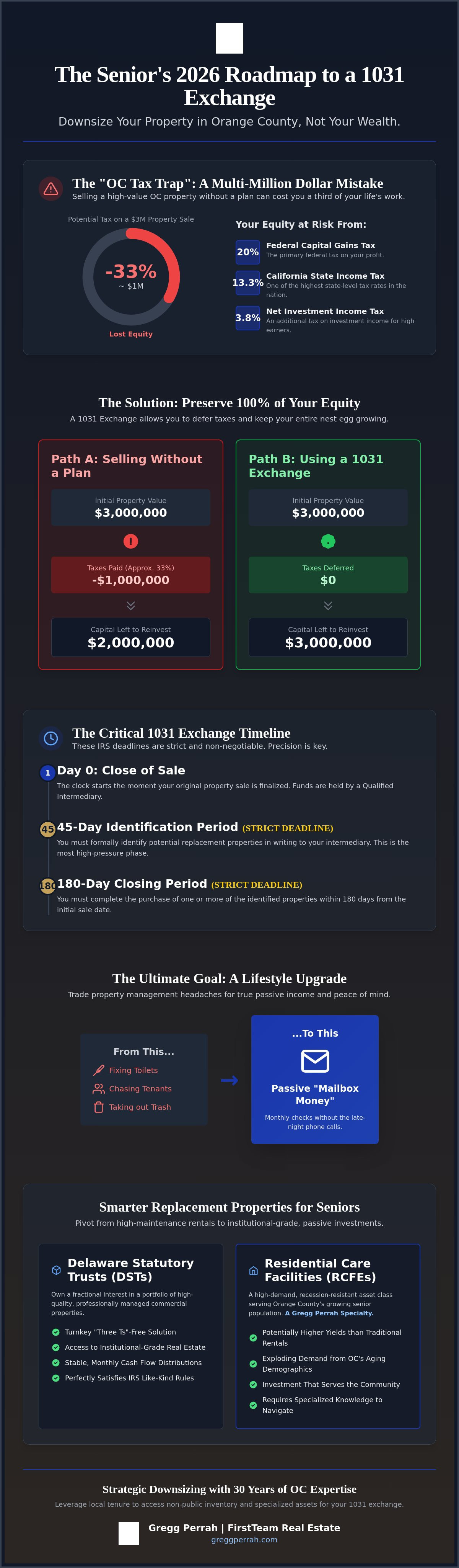
Have you calculated the "OC Tax Trap" lately? In 2026, high-income earners in California face a brutal reality. Between federal capital gains rates of 20%, the 3.8% Net Investment Income Tax, and California’s aggressive state income tax topping 13.3%, you could lose over 33% of your sale proceeds. Selling a $3 million rental property could mean writing a check for $1 million to the government. Don't let that happen. Use the tax code to your advantage and keep your hard-earned equity in your pocket.
It's vital to distinguish between your primary residence and your investment assets. Section 121 offers a tax exclusion for your home, but it's capped at $500,000 for married couples. In the Orange County market, your appreciation likely dwarfs that figure. Section 1031 applies to property held for investment or business use. It offers an uncapped path to tax deferral, allowing you to transition from active management to passive, lifestyle-oriented investments without a massive tax hit.
The Financial Benefits of Tax Deferral in 2026
Keep 100% of your equity working for you. When you defer taxes, you have more capital to reinvest, which leads to massive compounding growth for your estate. This strategy ensures your heirs receive a larger inheritance through a stepped-up basis later. Just remember to avoid "boot." Boot refers to any cash, debt relief, or non-like-kind property received in an exchange that triggers an immediate tax liability; seniors must avoid it to maintain full deferral.
Downsizing vs. Rightsizing: The Lifestyle Shift
Are you still managing a massive Newport Coast estate? It's time to trade the five-bedroom headache for a manageable luxury condo with ocean views. We call this "rightsizing." It means finally eliminating the "Three Ts": Toilets, Tenants, and Trash. As a Senior Real Estate Specialist with 30 years of experience, Gregg Perrah acts as your centralized resource center to make this emotional and financial move seamless. Stop managing assets and start enjoying them. Get the passive income you deserve while living in the Orange County home you actually want.
Evaluating Replacement Property Options: DSTs vs. Managed Rentals
You've successfully deferred your taxes. Now comes the critical question: where do you put the money? For a 1031 exchange for seniors downsizing Orange County, the goal isn't just growth. It's about lifestyle preservation and reliable cash flow. Do you want to spend your retirement chasing late rent payments, or would you rather receive "mailbox money" while enjoying the coast? Your choice of replacement property defines your next decade. Don't settle for a high-maintenance burden when you can pivot into a sophisticated, passive asset.
The DST Advantage for Orange County Seniors
Delaware Statutory Trusts (DSTs) have become the gold standard for downsizers. They allow you to own a fractional interest in institutional-grade real estate, such as a premier apartment complex or a massive distribution center. Because the trust handles all management, you're free from the "Three Ts" discussed earlier. This 1031 exchange investment strategy satisfies the IRS like-kind requirement perfectly while providing stable, monthly distributions. It's a turnkey solution for those who want to keep their equity working without the sweat equity.
RCFE Investments: The Gregg Perrah Specialty
If you're looking for higher yields and a "recession-proof" asset, look no further than Residential Care Facilities for the Elderly (RCFE). Orange County’s aging population is exploding, creating massive demand for quality care environments. Investing in an RCFE offers a unique ROI that traditional apartment buildings simply cannot match. It’s a specialized market that requires an insider's touch. Explore the current landscape in this RCFE for Sale guide to see why these assets are a local favorite for savvy investors.
Some seniors still prefer the familiarity of residential units. In that case, we look at smaller, high-yield rentals in Huntington Beach or Costa Mesa. These properties are easier to manage than a sprawling estate but still require some oversight. For those seeking maximum stability, Triple Net (NNN) leases are an excellent commercial alternative. In an NNN lease, the tenant pays for taxes, insurance, and maintenance. You simply collect the check. It’s the ultimate "set it and forget it" commercial play.
Choosing the right path requires a deep dive into your specific financial goals. Are you curious about how your current equity translates into these passive options? Let's run a professional investment property analysis to find your ideal fit. We'll compare the projected yields of DSTs against local OC rentals to ensure your retirement is fully funded and stress-free.
The Critical 1031 Exchange Timeline in the OC Market
Timing isn't just a factor in a successful exchange; it's the entire game. In the high-stakes world of Orange County real estate, a single day's delay can trigger a massive tax event. Your journey begins at Day 0, the moment escrow closes on your relinquished property. From that second, the clock is ticking. You must use a Qualified Intermediary (QI) to hold your sale proceeds. Don't even think about touching that cash. If those funds hit your personal bank account for even a second, the IRS considers the sale taxable. Your 1031 exchange for seniors downsizing Orange County dies right there.
Day 45 is the "danger zone." This is the Identification Period. You have exactly 45 calendar days to identify your replacement properties in writing to your QI. There are no extensions for holidays or weekends. In a low-inventory market like Newport Beach, 45 days feels like 45 minutes. If you haven't identified a property by midnight on the 45th day, you'll owe the full capital gains tax on your sale. This is where most seniors feel the pressure. You need a guide who already has a shortlist of assets ready before you even list your current home.
The final milestone is Day 180. This is your Completion Period. You must close escrow on your new passive investment within 180 days of your original sale. While six months sounds like a long time, complex commercial deals or DST closings can hit unexpected snags. Your strategy must be proactive, not reactive. We move fast to ensure your equity is safely transferred into your new income-producing asset well before the deadline looms.
Navigating Low Inventory in Newport Beach and Costa Mesa
How do you find the perfect "rightsized" home when inventory is at historic lows? You don't wait for the MLS. Success in this market requires "off-market" secrets and deep local connections. We identify potential replacement properties before your current asset even hits the market. This head start is the only way to survive the 45-day window. For a deeper look at current local dynamics, check out the Newport Beach Real Estate Guide 2026. We use these insights to secure your future while others are still searching.
The Penalty for Missing Deadlines
The IRS offers zero extensions for 1031 deadlines, regardless of market conditions or personal emergencies. If you miss the mark, you pay the price in full. This is why having a "Plan B" is mandatory for every OC seller. We often use Delaware Statutory Trusts (DSTs) as a backup identification to ensure you have a guaranteed place to move your money if a primary deal falls through. Gregg Perrah’s "always-on" approach means we are monitoring your timeline daily. We don't just hope for a smooth closing; we negotiate and push every party involved to meet these rigid federal requirements.
Common Pitfalls for Seniors Navigating Tax-Deferred Exchanges
Success in a 1031 exchange isn't guaranteed. It requires surgical precision. Many seniors in Newport Beach and Costa Mesa stumble because they overlook the rigid technicalities of the tax code. Why risk your financial legacy on a rookie mistake? One of the most frequent errors is confusing a primary residence with an investment asset. While Section 121 protects your home, only investment properties qualify for a 1031 deferral. If you’ve lived in the property recently, you must ensure it meets the "held for investment" criteria before starting the clock.
Another major trap is the "Debt-and-Equity" rule. To achieve 100% tax deferral, you must reinvest all net proceeds and replace any existing mortgage debt on the replacement property. If you trade down in value or fail to replace the debt, the difference is considered "boot" and is fully taxable. Don't assume you can just pocket the extra cash. Additionally, never choose a Qualified Intermediary (QI) based on the lowest fee. Your QI holds your entire net worth during the transition. Prioritize institutional security and a proven track record over a few hundred dollars in savings.
California presents its own unique challenges through the "clawback" rule. Even if you exchange into a property in another state, the Franchise Tax Board (FTB) tracks that deferred gain. You must file Form 3840 annually to report the status of your replacement property. If you eventually sell that out-of-state asset without another exchange, California will come knocking for its share of the original deferred gain. It's a persistent tax obligation that requires long-term planning and expert oversight from a centralized resource center.
The "Stepped-Up Basis" and Estate Planning
How does your real estate portfolio fit into your living trust? The smartest investors use the "Swap till you drop" strategy. By continuously utilizing a 1031 exchange for seniors downsizing Orange County, you keep your equity growing tax-deferred until your passing. At that point, your heirs receive a "stepped-up basis" to the current market value. This effectively wipes out decades of capital gains taxes. It’s the ultimate wealth preservation tool. Consult with your local tax professional to ensure your exchange aligns perfectly with your estate goals.
The Danger of "Constructive Receipt"
Don't touch the money. Ever. Taking even one dollar of profit out of escrow triggers "constructive receipt," making the entire transaction taxable. You must structure the sale of your luxury asset to ensure all funds flow directly to your QI. This is why you need Luxury Real Estate Agents who understand the high stakes of these transactions. We manage the paperwork and the players to keep your exchange valid and your equity protected.
Ready to avoid these traps and secure your passive income? Let's analyze your current debt-to-equity ratio today. Request a professional investment property analysis to see how much equity you can safely transition into your next passive asset.
Strategic Downsizing with Gregg Perrah: 30 Years of OC Expertise
Why trust your 2026 wealth preservation to a global brand that doesn't know your neighborhood? In the high-stakes markets of Newport Beach and Costa Mesa, local tenure isn't just a badge of honor. It's your greatest competitive advantage. Gregg Perrah has been a tireless force in Orange County real estate since 1997. He operates as a centralized resource center, providing more than just a transaction. He offers a sophisticated knowledge base built over three decades of market cycles. When you're executing a 1031 exchange for seniors downsizing Orange County, you need an insider who knows the non-public inventory and off-market opportunities that never hit the MLS.
We provide a full-service concierge experience that handles every detail from initial valuation to final identification. You aren't just selling a property; you're transitioning your legacy. Our process begins with a deep-dive investment property analysis to determine exactly how much equity we can pivot into passive income. We don't guess. We use hard data and localized insights to ensure your next move is your smartest move. Stop settling for general practitioners. Hire a specialist who understands the specialized nuances of facility-based assets and luxury residential downsizing.
The SRES Advantage: Specialized Senior Support
Selling a long-term family asset carries significant emotional weight. It's more than a financial shift; it's a life transition. As a Senior Real Estate Specialist (SRES), Gregg understands this burden perfectly. We coordinate the entire move, working alongside your estate planners, movers, and family members to ensure a seamless handoff. Our tireless work ethic is focused entirely on your 2026 retirement goals. We manage the stress so you can focus on the lifestyle you've earned. Let us handle the negotiations while you plan your next chapter in a manageable, luxury environment.
Immediate Action: Get Your Asset Valuation
What is your property actually worth in today's shifting market? Knowing your current value is the critical first step in any 1031 journey. Stop guessing and start planning with professional precision. A comprehensive valuation reveals the true potential of your 1031 exchange for seniors downsizing Orange County. It's time to see how your current equity can be transformed into a passive, management-free portfolio. Don't wait for the market to move without you. Take the lead and secure your financial future now.
Ready to see the numbers? Contact Gregg Perrah for a confidential 1031 consultation today. We'll analyze your asset, explore your replacement options, and build a roadmap for your wealth preservation.
Secure Your Passive Income Future in Orange County
Don't let your hard-earned equity evaporate into unnecessary taxes. You've seen how a 1031 exchange for seniors downsizing Orange County can transform a high-maintenance property into a reliable stream of passive income. Whether you choose the "mailbox money" simplicity of a DST or the high-demand yield of an RCFE, the strategy remains the same: stop working for your real estate and make your real estate work for you. Remember that the IRS is rigid with its 45-day and 180-day deadlines. Missing these marks isn't an option when your retirement security is on the line.
You need a veteran negotiator who understands the local nuances of Newport Beach and Costa Mesa. With over 30 years of industry experience and a specialized SRES certification, Gregg Perrah provides the expert investment property analysis you need to move forward with confidence. We offer the insider access and tireless dedication required to navigate these high-stakes transactions successfully. It's time to trade the stress of active management for the freedom of a rightsized lifestyle.
Ready to take the first step toward a tax-free transition? Stop guessing about your property's value and start building your 2026 wealth preservation roadmap. Secure Your Retirement: Schedule a 1031 Strategy Session with Gregg Perrah today. Your new chapter of passive income and coastal living is waiting for you.
Frequently Asked Questions
Can I use a 1031 exchange to buy a home I plan to live in eventually?
Yes, but you must follow the IRS Safe Harbor rules under Revenue Procedure 2008-16 strictly. You're required to rent the property at fair market value for at least 14 days in each of the first two years after the exchange. Your personal use must be limited to 14 days or 10% of the rental period during those years. Don't move in too early or you'll trigger a massive tax bill and disqualify the entire exchange.
What happens if I sell my Newport Beach rental but cannot find a replacement in 45 days?
If you miss the 45-day identification window, your exchange is disqualified immediately. The IRS does not grant extensions for low inventory, market conditions, or personal emergencies. Your sale proceeds, held by the Qualified Intermediary, will be released to you and become fully taxable. This is why we identify "Plan B" assets like Delaware Statutory Trusts early in the process to ensure you have a backup option.
How does the California "clawback" rule affect my 1031 exchange?
The California "clawback" rule means the Franchise Tax Board tracks your deferred gain even if you buy replacement property in another state. You must file Form 3840 with the state every year to report the status of that out-of-state asset. If you eventually sell that property without performing another 1031 exchange, California will collect the taxes you deferred on the original Orange County sale.
Is a Delaware Statutory Trust (DST) better for seniors than a traditional rental?
A DST is often superior for seniors who want to eliminate the stress of active property management. It provides institutional-grade passive income without the "Three Ts" of toilets, tenants, and trash. For a 1031 exchange for seniors downsizing Orange County, DSTs offer a turnkey solution to meet strict IRS deadlines while securing reliable monthly distributions. It's the ultimate "mailbox money" strategy for a work-free retirement.
Do I need a Senior Real Estate Specialist (SRES) for a 1031 exchange?
While not a legal requirement, an SRES brings specialized knowledge to the emotional and technical aspects of senior transitions. We understand the high stakes of estate planning, stepped-up basis, and the physical challenges of downsizing a long-term family home. You need a veteran who handles more than just the contract. You need a guide who coordinates with tax professionals and family members for a seamless move.
What are the costs associated with hiring a Qualified Intermediary in Orange County?
Fees for a Qualified Intermediary (QI) vary based on the complexity of your transaction and the number of replacement properties you identify. You'll generally encounter a base setup fee and additional costs for each property involved in the exchange. Don't shop for a QI based on the lowest price. Focus on the security, insurance, and institutional bonding of the firm holding your sale proceeds during the 180-day window.
Can I combine my primary residence exclusion (Section 121) with a 1031 exchange?
You can combine these sections if your property has been used for both personal and investment purposes. This often applies to multi-unit buildings where you live in one unit or homes with a dedicated guest house used as a rental. You apply the Section 121 exclusion to your living space and the 1031 exchange for seniors downsizing Orange County to the investment portion. This strategy maximizes your total tax deferral.
How much time do I have to close on my new property after identifying it?
You have exactly 180 calendar days from the close of your original escrow to finalize the purchase of your replacement property. This 180-day completion period runs concurrently with your 45-day identification window. It's not 45 days plus 180 days; it's 180 days total. You must move quickly on inspections and financing to ensure you meet this rigid federal deadline. There are no extensions allowed for any reason.


