

Why would you hand over 37% of your investment profits to the government when you could keep that capital working for your legacy? If you're holding appreciated real estate in Newport Beach or Costa Mesa, the tax hit on a standard sale is enough to stall your growth. You've worked too hard for your equity to let progressive state rates and federal recapture eat your ROI. It's time to stop settling for "taxable" and start thinking "tactical."
A properly structured 1031 exchange for investment property in California is your most powerful tool to defer 100% of those taxes and scale your portfolio. We know the pressure of the strict 45-day identification window in a low-inventory market. This 2026 guide gives you the exact blueprint to beat the clock. You'll learn how to handle the California claw-back rule on Form 3840 and discover how to transition into high-yielding assets like an RCFE. We'll break down the federal deadlines, the state reporting requirements, and the off-market strategies that seasoned Southern California investors use to stay ahead.
Key Takeaways
- Defer 100% of federal and state capital gains taxes to keep your equity working for your long-term legacy.
- Navigate the high-stakes 45-day identification window with proven strategies for low-inventory markets like Newport Beach and Huntington Beach.
- Execute a 1031 exchange for investment property in California to transition from residential rentals into high-yielding RCFE and senior housing assets.
- Protect your out-of-state reinvestments by mastering the 2026 California claw-back rules and mandatory FTB reporting requirements.
- Secure access to non-public, off-market inventory to ensure you meet rigid IRS deadlines without settling for sub-par returns.
What is a 1031 Exchange for Investment Property in California?
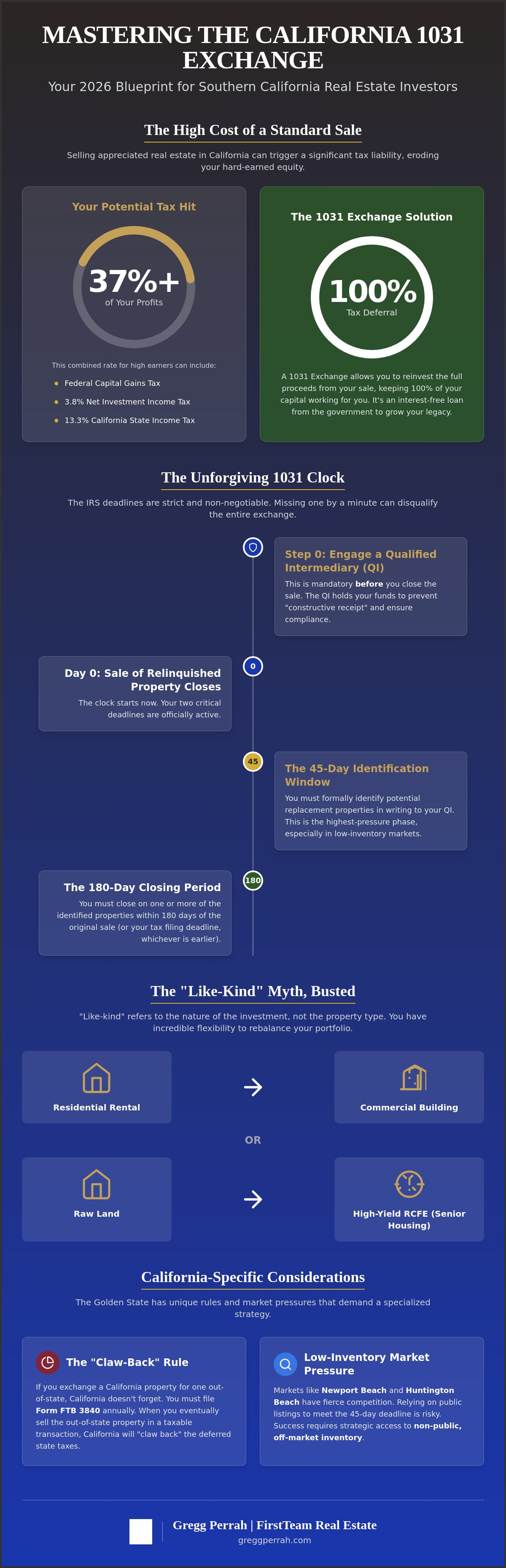
Why let the government take a massive cut of your hard-earned equity? If you sell an investment property in the Golden State, you face a combined tax hit that can exceed 37% for high earners. That includes federal gains, the 3.8% Net Investment Income Tax, and California’s aggressive 13.3% top income tax bracket. A 1031 exchange for investment property in California isn't a loophole; it's a sophisticated wealth-building engine. It allows you to sell your "relinquished" property and reinvest the proceeds into a "replacement" property while deferring 100% of your capital gains and depreciation recapture taxes.
The legal foundation for this strategy is Internal Revenue Code section 1031. This federal provision dictates that no gain or loss is recognized on the exchange of real property held for productive use in a trade or business or for investment. In 2026, this is critical for Southern California investors. With property values in Newport Beach and Costa Mesa sitting at historic highs, your equity is a powerful tool. Don't let it sit stagnant. Use an exchange to rebalance your portfolio and move into higher-yielding assets without losing a third of your buying power to the Franchise Tax Board.
Understand the "Held for Productive Use" rule. You cannot use a 1031 exchange for your primary residence or a property you intend to "flip" immediately. The IRS looks for investment intent. Whether you own a single-family rental, a multi-unit complex, or raw land, the asset must be held for the purpose of generating income or long-term appreciation.
The "Like-Kind" Property Myth
Many investors believe "like-kind" means you must trade a house for a house. This is false. The term refers to the nature or character of the investment, not its specific grade or quality. You have incredible flexibility. You can exchange a residential rental in Newport Beach for a commercial building in Huntington Beach. You can even trade into specialized assets like Residential Care Facilities for the Elderly (RCFEs). Because RCFEs involve real property held for business use, they are a premier target for investors looking to transition from passive rentals into high-cash-flow operations. The property types don't have to match; the investment intent does.
Why California Investors Need a Strategy, Not Just a Form
California is a high-tax jurisdiction with unique reporting requirements. Simply filling out a form won't protect you from the "claw-back" rule if you move your capital out of state. Think of a 1031 exchange as an interest-free loan from the government. Every dollar you defer is a dollar that continues to compound in your favor. In a competitive market, you need more than a transactional agent. You need a centralized resource center that understands asset valuation and non-public inventory. Are you ready to stop paying the "exit tax" and start growing your Orange County legacy? It starts with a plan, not a prayer.
The 1031 Exchange Rules: Timelines and California Specifics
The clock starts ticking the second you close escrow on your relinquished property. You have exactly 45 days to identify a replacement and 180 days to close. There are no extensions. No exceptions for holidays. No grace periods for weekends. If you miss a deadline by one minute, your 1031 exchange for investment property in California fails, and the tax bill arrives in full. You need a strategy that moves as fast as the market does.
Step one is non-negotiable. You must engage a Qualified Intermediary (QI) before you close the sale of your current asset. If you touch the sale proceeds, the exchange is disqualified immediately. The QI holds your funds in a secure account, ensuring you never have "constructive receipt" of the cash. Understanding these 1031 Exchange Rules And Basics is the first step toward securing your capital. Once the sale closes, you enter the 45-day identification window. This is the danger zone. In a low-inventory environment like Newport Beach, finding viable properties in six weeks is a high-stakes race. Don't rely on public listings alone. You need access to non-public inventory to ensure your identification list is bulletproof. If you are struggling to find a match, request a custom search of off-market assets to stay ahead of the deadline.
The final hurdle is the 180-day completion period. You must close on your replacement property within 180 days of the original sale or by your tax return due date, whichever comes first. During this time, you must also manage the "boot." If you trade down in value or reduce your mortgage debt without adding cash, the difference is considered taxable boot. To defer 100% of your taxes, you must reinvest all net proceeds and acquire debt equal to or greater than what you relinquished.
The California Claw-Back Provision Explained
California doesn't let go of its tax revenue easily. If you exchange a property in Costa Mesa for one in Arizona or Texas, the Franchise Tax Board (FTB) keeps a watchful eye on that deferred gain. You are required to file FTB Form 3840 every year. This form tracks the "California-source" gain. If you eventually sell the out-of-state property in a taxable transaction, California will "claw back" its share of the original deferred gain. This is a perpetual reporting requirement that lasts as long as you hold the replacement property.
The Same Taxpayer Rule and Title Issues
Vesting is where many investors trip up. The entity that sells the old property must be the exact same entity that buys the new one. If your Newport Beach rental is held in a specific LLC, the replacement property must be titled to that same LLC. Problems arise when partners want to go their separate ways or when investors try to change title to a personal name mid-exchange. While certain "disregarded entities" like single-member LLCs or revocable trusts offer some flexibility, you must coordinate title changes with your QI and CPA well before the first closing to avoid a total exchange collapse.
Southern California Market Strategy: Finding Replacement Property
Are you waiting for a public listing to save your exchange? In high-demand markets like Newport Beach and Huntington Beach, relying on the MLS is a recipe for failure. Inventory is tight. Competition is aggressive. With approximately 19% of California homes owned by investors, you're fighting for a limited pool of assets. A successful 1031 exchange for investment property in California requires an insider's edge. You need access to the non-public inventory that never hits the open market. This is where professional longevity pays off. We leverage a network built over 26 years to find motivated sellers before they plant a sign in the yard.
How do you choose your targets? You must master the identification rules immediately. Most investors utilize the "Three-Property Rule." This allows you to identify up to three potential replacement properties regardless of their total fair market value. If you need a more diversified approach, the "200% Rule" lets you identify any number of properties, provided their combined value doesn't exceed double the price of your relinquished asset. In Costa Mesa, we analyze Cap Rates and ROI with surgical precision. Don't just buy a property; buy a cash-flow engine that justifies the move.
Beating the 45-Day Clock in Orange County
The 45-day window is a sprint, not a marathon. Start your search before you even list your current property. Proactive investors identify their top targets while their own asset is still in escrow. This gives you the leverage to negotiate with confidence. Always include backup properties in your identification letter. If your primary choice falls through during due diligence, you must have a pre-vetted secondary option ready to go. We act as your centralized resource center, vetting off-market opportunities so you can hit the ground running on day one.
Transitioning from Residential to Commercial Assets
Tired of the "three Ts" of residential landlording: tenants, toilets, and trash? Many seasoned investors are trading their single-family rentals for the stability of NNN leases or specialized commercial assets. This shift is particularly popular among seniors looking for passive income without the management headaches. Evaluating commercial property for sale Costa Mesa provides a gateway to higher yields and institutional-grade tenants. Diversify your portfolio across strategic zip codes. Move your equity from a stagnant residential unit into a high-performing commercial asset that builds your Southern California legacy.
Niche 1031 Opportunities: RCFEs and Senior Housing
Are you tired of chasing 4% cap rates on single-family homes that require constant maintenance? It is time to look at Residential Care Facilities for the Elderly (RCFEs). These properties represent a premier target for a 1031 exchange for investment property in California. They combine high-demand real estate with a recession-resistant business model. With the aging population in Orange County growing rapidly, these facilities offer a level of stability that traditional retail or office spaces often lack in the current cycle. You aren't just buying a building; you're securing a foothold in a critical infrastructure niche.
Execution requires a sophisticated understanding of asset valuation. You must separate the business value from the real estate value during the exchange. The IRS allows you to defer taxes on the real property component, but the business value is handled differently. Owning both the facility and the business allows you to capture lease income and operational profits simultaneously. This creates a powerful dual-revenue stream. As a Senior Real Estate Specialist (SRES) with a 26-year tenure, I help you navigate these specialized requirements to ensure your exchange remains fully compliant while maximizing your cash flow.
Evaluating RCFE Investment Potential
The best opportunities in the care industry never hit the public market. Orange County has a massive "non-public" RCFE inventory that requires an insider's network to access. Valuation in this sector depends on bed capacity, licensing status, and local demand metrics. If you want to understand the specialized metrics of these assets, read our RCFE for sale strategic guide. We provide the fiscal clarity you need to assess whether a facility meets your ROI goals before you commit your exchange capital.
The Downsizing Strategy for Senior Investors
Are you a senior investor managing a high-maintenance residential portfolio? A 1031 exchange for investment property in California is your gateway to a "Swap Till You Drop" strategy. Move your equity from labor-intensive rentals into passive income streams or higher-yielding senior housing assets. This move protects your legacy. By deferring taxes now, you provide your heirs with a stepped-up basis upon your passing. This effectively eliminates the deferred capital gains tax liability for the next generation. Experience matters when handling these legacy-defining moves. We act as your centralized resource center to ensure every detail is managed with the urgency your timeline demands.
Stop settling for average returns and start building a recession-proof legacy. Access our exclusive list of off-market RCFE and senior housing opportunities today.
Maximize Your Deferral: Why Professional Facilitation is Mandatory
A 1031 exchange for investment property in California is a high-stakes financial maneuver. It isn't a DIY project. You need a synchronized team to protect your equity. Your Qualified Intermediary (QI) handles the funds; your CPA tracks the tax liability; your broker finds the replacement asset. If these three pillars don't communicate perfectly, you risk a taxable event. A transactional agent who only handles standard residential sales won't understand the nuances of depreciation recapture or the specific reporting for out-of-state exchanges. You need an expert who functions as a centralized resource center for your entire portfolio.
Think about the risk of a failed exchange. If your broker doesn't understand the "Three-Property Rule" or fails to vet a replacement property's debt requirements, your deferral collapses. We provide rigorous investment property analysis to ensure the numbers work before you sign. We don't just look at the purchase price. We analyze cap rates, net operating income, and long-term appreciation potential. This level of fiscal clarity is the difference between simply buying a property and securing your financial future. Are you ready to trade up with confidence?
The Gregg Perrah Advantage in Southern California
I've been navigating these volatile California market cycles since 1997. That tenure isn't just a number; it represents nearly three decades of building a deep network of non-public inventory in Newport Beach and Huntington Beach. When you are in your 45-day identification window, you don't have time to wait for a return call. I provide an "always-on" approach. You get immediate responses because your equity is on the line. We specialize in finding motivated sellers and off-market assets that generic search engines miss. This is the insider advantage required to beat the clock in a low-inventory landscape.
Next Steps: Get Your Asset Valuation
The first step in any successful exchange is a professional investment analysis. You must know exactly what your current asset is worth in today's market to determine your reinvestment requirements. We prepare your property for a high-value sale that maximizes your exchange capital. Don't wait until you're in escrow to start planning your next move. Start the process now by securing a comprehensive valuation of your Newport or Costa Mesa holdings. We'll help you prepare the documentation, vet the replacement targets, and coordinate with your tax professionals to ensure a seamless transition into a higher-yielding asset.
Don't leave your legacy to chance. Schedule your 1031 exchange consultation with Gregg Perrah today and take control of your Southern California portfolio.
Secure Your Legacy with a Strategic Move
Don't let your equity sit stagnant while taxes erode your purchasing power. A successful 1031 exchange for investment property in California is about more than just meeting a deadline. It's about positioning your capital for maximum growth in a competitive market. You already know how strict timelines and complex reporting requirements like the California claw-back rule can derail an unprepared investor. Why take that risk when you can leverage nearly three decades of local expertise?
You need a guide who understands the niche RCFE market and commercial landscape of Newport Beach. With 26+ years of experience and a Senior Real Estate Specialist (SRES) designation, I provide the "always-on" advocacy required to secure your financial future. Whether you're downsizing or diversifying into care facilities, we find the non-public opportunities others miss. Ready to start your transition? Contact Gregg Perrah for Expert 1031 Exchange Facilitation today. Your Southern California portfolio is ready for its next level of growth; let's make it happen.
Frequently Asked Questions
Can I do a 1031 exchange on a primary residence in California?
No, you cannot use a 1031 exchange for a primary residence. This tax-deferral strategy is strictly reserved for properties held for productive use in a trade or business or for investment purposes. If you are selling your home, you should look into the Section 121 exclusion. That federal rule allows single filers to exclude up to $250,000 in gains, while married couples can exclude $500,000. Keep your personal and investment assets separate to stay compliant.
How long do I have to identify a replacement property in a 1031 exchange?
You have exactly 45 calendar days from the closing of your relinquished property to identify a replacement. This deadline is federally mandated and strictly enforced by the IRS. There are no extensions for weekends or holidays. You must submit your identification list in writing to your Qualified Intermediary by midnight on the 45th day. Because this window is incredibly tight, starting your search before you even close your sale is the only way to protect your 1031 exchange for investment property in California.
What is the California claw-back rule for 1031 exchanges?
The California claw-back rule allows the Franchise Tax Board to track and eventually tax gains from California properties that were exchanged for out-of-state assets. If you move your equity from Newport Beach to a state like Arizona, you must file FTB Form 3840 every year. This form tracks the "California-source" gain. If you eventually sell that out-of-state property in a taxable transaction, California will "claw back" its share of the original deferred tax. It is a perpetual reporting requirement.
Do I need a Qualified Intermediary (QI) for a 1031 exchange in California?
Yes, engaging a Qualified Intermediary is a mandatory requirement for a valid exchange. You are legally prohibited from having "constructive receipt" of the sale proceeds. If the money touches your personal bank account for even one second, the exchange is disqualified and the taxes are due. The QI acts as a neutral third party, holding your funds in a secure account and transferring them directly to the escrow of your replacement property to maintain the tax-deferred status.
Can I buy a property for less than I sold for in a 1031 exchange?
You can buy a cheaper property, but the difference in value is considered "boot" and is fully taxable. To defer 100% of your capital gains, you must reinvest all net proceeds and acquire a replacement property of equal or greater value. Any cash you keep or any reduction in your mortgage debt is treated as a taxable gain. While "trading down" is allowed, it triggers a tax bill that most investors prefer to avoid through careful investment property analysis.
What qualifies as "like-kind" property in California?
In the world of real estate, "like-kind" is defined very broadly as any property held for investment or business use. You don't have to trade a house for a house. You can exchange raw land for an apartment complex, a retail center for a warehouse, or a residential rental for an RCFE. As long as the intent is investment or business use, the properties qualify. This flexibility allows you to pivot your Southern California portfolio into higher-yielding asset classes as market conditions change.
What happens if I miss the 45-day identification deadline?
If you miss the 45-day deadline by even one minute, your exchange fails and the full tax liability is triggered. The IRS offers no grace periods or extensions for missed identifications. You will be required to pay federal capital gains, state income taxes, and depreciation recapture in the current tax year. This is why access to non-public inventory is critical. We focus on securing your replacement targets early so you aren't left scrambling as the clock runs out.
Can I use 1031 exchange funds to renovate the new property?
You cannot use standard exchange funds to renovate a property after you have already taken title. If you want to use tax-deferred capital for improvements, you must structure a "Build-to-Suit" or "Improvement" exchange. This requires your Qualified Intermediary to hold the title while the renovations are performed. All work must be completed and the property must be transferred to you within the 180-day exchange period. It is a complex process that requires expert coordination from the start.