

Are you still chasing rent checks and managing midnight plumbing emergencies while your capital gains tax liability grows? For many Orange County landlords, the traditional 1031 exchange feels less like an investment strategy and more like a high-stakes race against a 45-day clock. You have spent decades building your equity. Why should you lose a massive chunk of it to the IRS or settle for a subpar replacement property just to beat a deadline? If you are ready to stop being a landlord and start being an investor, it is time to look at dst investments.
You already know that active management is exhausting, especially in the current California regulatory environment. You want the income without the headaches. This article shows you how Delaware Statutory Trusts (DSTs) provide a seamless exit strategy that defers your taxes and moves your capital into institutional-grade assets. We will explore the 2026 tax landscape, including the 60% bonus depreciation rate, and explain how you can secure fractional ownership in major multifamily or industrial projects with zero management responsibilities. Discover how to protect your legacy, eliminate the stress of the 45-day identification period, and finally reclaim your time.
Key Takeaways
- Stop chasing rent and start collecting passive income. Understand why dst investments serve as the ultimate tax-deferred exit strategy for Southern California property owners.
- Gain exclusive access to institutional-grade real estate. You can own a fractional interest in Class A medical offices or Amazon-scale industrial facilities without the management burden.
- Beat the 45-day identification clock. Learn how to pre-vet replacement properties so you don't lose your hard-earned equity to capital gains taxes.
- Simplify your transition from active landlord to passive investor. We break down the step-by-step process of moving from a local rental to a diversified national portfolio.
- Rely on a veteran negotiator with 26 years of tenure. Secure the insider knowledge required to analyze complex investment assets and maximize your 1031 exchange results.
What are DST Investments and Why are OC Investors Moving to Them?
Are you tired of being on call for your tenants? A Delaware Statutory Trust (DST) is a separate legal entity that allows you to own a fractional interest in institutional-grade real estate. This isn't a REIT or a traditional partnership. It is a specific ownership structure that the IRS treats as direct property ownership. For the savvy Orange County investor, dst investments offer a way to keep your 1031 exchange benefits while deleting the "landlord" title from your resume. You get the tax deferral. You get the income. You lose the headaches.
The Legal Framework: Revenue Ruling 2004-86
IRS Revenue Ruling 2004-86 is the bedrock of this strategy. It explicitly confirms that a beneficial interest in a DST is "like-kind" real estate for tax purposes. This means you can sell your Newport Beach rental and move the proceeds into a DST without triggering a massive capital gains tax hit. Why is it so passive? The "Seven Don'ts" of DSTs ensure the sponsor handles every operational detail. Under these rules, the trust cannot raise new capital, renegotiate existing debt, or reinvest sales proceeds. These restrictions create a stable, fixed pool of assets. A DST is a passive investment vehicle under Section 1031 that allows for fractional ownership of high-value, professionally managed assets.
Why Newport Beach and Costa Mesa Landlords are Exiting
Why are so many local owners selling now? Property values in coastal Orange County have reached historic peaks. Managing a Costa Mesa triplex or a Newport Beach rental is becoming a full-time job with diminishing returns on your time. You are likely dealing with rising insurance premiums, aggressive tenant laws, and constant maintenance. It's an exhausting cycle. Many investors are choosing to trade one high-priced, high-maintenance OC asset for a diversified national portfolio. Why bet your entire retirement on a single zip code? You can check the Newport Beach Real Estate Guide 2026 to see just how much equity you are currently sitting on. It's time to turn that equity into consistent mailbox money.
Who is the typical investor making this move? It's the "tired landlord" who wants their weekends back. It's the retiring RCFE owner who needs to transition business equity into a hands-off income stream. dst investments provide the institutional quality you want without the 2:00 AM phone calls. Are you ready to stop managing and start living? The transition is simpler than you think. You have spent decades building your portfolio; now it's time to let your portfolio work for you.
The Benefits of DSTs: Institutional Quality Without the Headaches
Why settle for a single-family home in Huntington Beach when you can own a piece of a Class A medical office or a massive Amazon distribution center? dst investments give you a seat at the table with the world's largest institutional players. You aren't just buying real estate. You're buying a total lifestyle change. Stop worrying about Newport Beach tenant disputes or the rising cost of maintenance in Costa Mesa. In a DST, a professional sponsor handles every operational detail. You get the income. They get the 2:00 AM phone calls. This is the ultimate "exit ramp" for landlords who are ready to retire from active management but aren't ready to pay the IRS.
Have you ever felt the panic of the 45-day 1031 identification period? Many traditional exchanges fail because a deal falls through at the last minute, leaving the investor with a massive tax bill. DSTs eliminate this "failed exchange" nightmare. These offerings are typically pre-packaged and ready to close immediately. You can identify your replacement property and complete the transaction in a matter of days. This level of closing certainty is a strategic advantage in a volatile market. If you want to see how these assets fit into your specific financial picture, you should consult with a specialist in investment property analysis to review current inventory.
Portfolio Diversification Strategies
Don't put all your eggs in one basket. If your entire net worth is tied to a single rental in Orange County, you are vulnerable to local market shifts. Geographic diversification is the key to long-term stability. Why not trade that one high-priced OC asset for a diversified portfolio that includes Texas industrial hubs or Florida multifamily complexes? For senior investors, this approach mitigates risk. You spread your capital across different asset classes and states, ensuring that your retirement isn't dependent on the performance of a single zip code. It's a sophisticated way to protect the equity you've spent decades building.
Passive Income and Tax-Deferred Growth
How would your life change with consistent, potential monthly distributions? DSTs are designed to provide regular cash flow without the friction of active management. You still receive your proportional share of depreciation and interest deductions, just as you would with a traditional rental. As established by IRS Revenue Ruling 2004-86, these interests qualify as direct property ownership. This allows for the continued deferral of capital gains and depreciation recapture. You keep your money working for you, compounding over time, rather than handing a third of it to the government. It's time to stop working for your buildings and let your buildings start working for you.
DST vs. Traditional 1031: The Ultimate "Exit Ramp" Comparison
Are you ready to hand over the keys? Most investors struggle with this question. In a traditional 1031 exchange, you remain the captain of the ship. You choose the property, manage the tenants, and oversee the repairs. It's active. It's demanding. It's a job. Conversely, dst investments require you to step out of the driver's seat entirely. You trade control for freedom. For many, letting go of the steering wheel is the hardest part of the transition. But ask yourself: is the "control" of managing a single-family rental worth the stress of a midnight flood or a legal dispute?
The Delaware statutory trust structure is a long-term play. These aren't liquid assets you can flip in six months. Expect a hold period of five to ten years. This illiquidity is the trade-off for institutional-grade stability and tax-deferred growth. If you need immediate access to your principal, a DST isn't for you. But if you want to secure your equity and generate a reliable income stream while you enjoy your retirement, this is your exit ramp. Stop working for your money and start letting your money work for you.
The RCFE Owner’s Dilemma
Selling a Residential Care Facility for the Elderly (RCFE) in Orange County is a massive undertaking. You aren't just selling real estate; you're selling a high-stress, highly regulated business. How do you retire from that level of intensity without losing 30% or more of your wealth to capital gains taxes? A DST provides the perfect solution. You can sell your facility, defer the taxes, and move straight into a hands-off investment. It is a seamless transition from the front lines of caregiving to the peace of passive ownership. Read our RCFE for Sale: The 2026 Strategic Guide to understand how to position your asset for a maximum-value exit.
Evaluating the Fee Structure
Let's talk about the numbers. Yes, dst investments come with upfront costs, often referred to as "load." These fees cover sponsor acquisition, organization, and offering expenses. Don't let the gross yield distract you. You must focus on the net return. Why do investors accept these fees? Because the institutional scale of a DST often secures better financing terms and lower interest rates than an individual investor could ever get on their own. The non-recourse debt and professional management often result in a superior risk-adjusted return. Look past the entry price and evaluate the long-term fiscal clarity these trusts provide.
Navigating the 1031 DST Timeline in Orange County
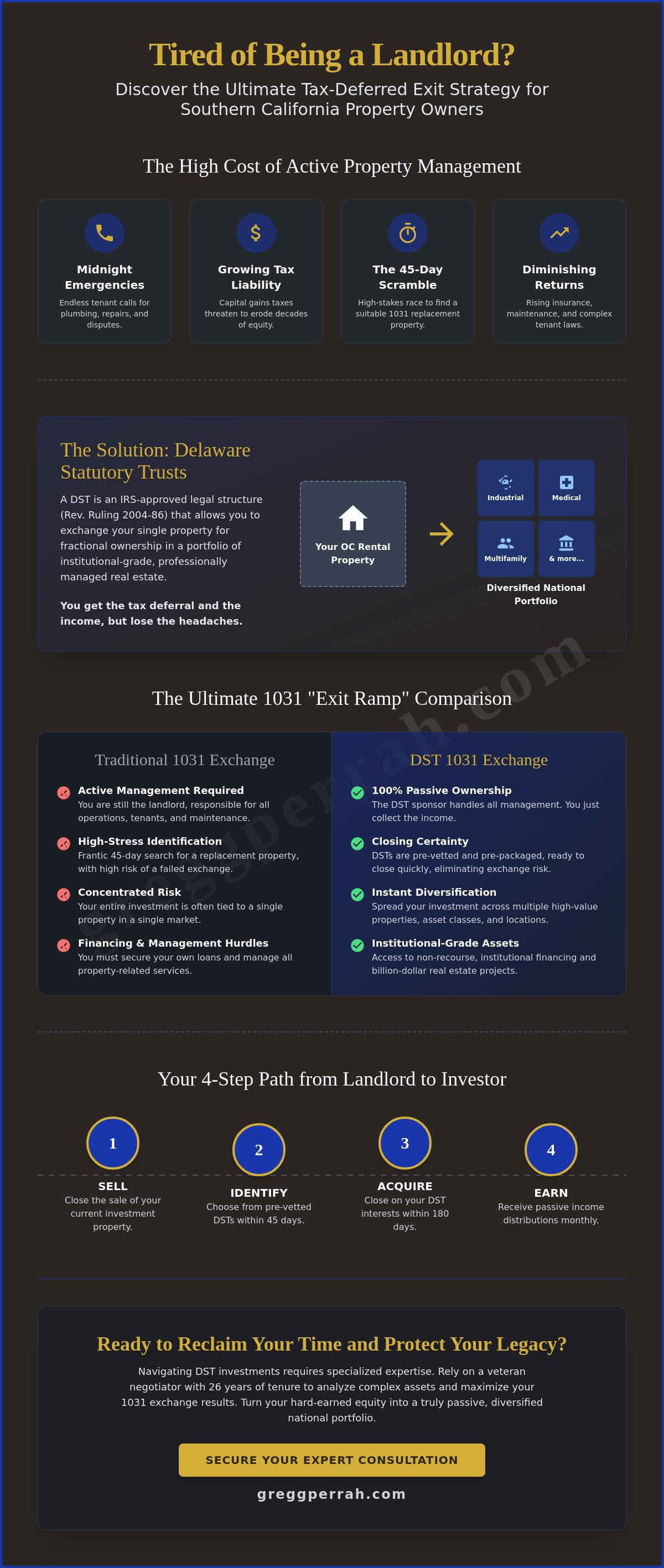
The 1031 clock is ruthless. From the moment you close escrow on your relinquished property, you have exactly 45 days to identify your replacement. There are no extensions. There are no excuses. In a market as tight as Orange County, finding a traditional property that meets your needs and is actually available is a high-risk gamble. This is where dst investments become your tactical advantage. They provide a streamlined path to tax deferral without the frantic search for a local building that might not even exist.
Success requires a disciplined, step-by-step approach. Follow this timeline to protect your equity:
- Step 1: List your relinquished property, such as a Costa Mesa triplex, and secure a solid buyer.
- Step 2: Engage a Qualified Intermediary (QI) before your escrow closes. If you take possession of the funds, the IRS will disqualify your exchange.
- Step 3: Identify your replacement DST properties within the 45-day window.
- Step 4: Execute your identification letter with absolute precision. One clerical error can trigger a massive tax hit.
- Step 5: Close on your DST interest within the 180-day period. Because these assets are pre-vetted and structured, the closing often happens in a matter of days.
The 45-Day Identification Crunch
Why gamble with a traditional purchase? In Newport Beach or Irvine, inventory is scarce. If your primary target fails inspection on day 40, you are in trouble. Position a DST as your "backstop" or safety net. You can use the "3-Property Rule" to identify three potential assets or the "200% Rule" if you are diversifying into a larger portfolio. This strategy ensures you never leave your hard-earned capital exposed to the IRS just because a local deal fell through.
Pre-Closing Due Diligence
Do not skip the legwork. You must vet the DST sponsor's track record and total Assets Under Management (AUM). Look for a history of full-cycle successes where properties were bought, managed, and sold profitably. Review the Private Placement Memorandum (PPM) with your tax advisor to understand the specific risks. Real-time inventory moves fast. You need a veteran partner who tracks non-public opportunities as they hit the market. If you are ready to secure your timeline and protect your wealth, contact us for expert 1031 exchange facilitation today.
Why Gregg Perrah is Your DST and 1031 Advantage
Experience isn't just a number. It's your primary shield against IRS audits and failed exchanges. When you're moving millions in equity, you don't hire a generalist. You hire a veteran. I bring over 26 years of tenure to the Southern California real estate landscape. I've navigated every market cycle since the late 90s. This deep local history isn't just about knowing the zip codes. It's about having direct access to non-public inventory and elite institutional sponsors for dst investments. My specialized expertise in RCFE business sales and complex investment property analysis ensures your transition is handled with surgical precision. Under the FirstTeam Real Estate umbrella, you receive institutional sophistication combined with a personal, local Newport Beach touch that global firms simply can't replicate.
Beyond the Transaction: A Comprehensive Resource Center
I operate as a centralized resource center, not just a brokerage. I don't just sell your property and leave you to figure out the rest. My mission is to connect you with the industry's most reliable Qualified Intermediaries (QIs), specialized tax professionals, and vetted DST sponsors. 1031 deadlines are ruthless and they don't care about your schedule. You need an "always-on" advocate who commits to immediate responses and proactive problem-solving. Why guess your property's value in a shifting market? Start your exit plan today with a no-obligation asset valuation. It's time to get the fiscal clarity you deserve. We provide the keys to a network built over decades, ensuring you have every tool required for a successful exchange.
Ready to Stop Managing and Start Investing?
Don't let a failed 1031 exchange drain your wealth. A single clerical error or a missed identification deadline can cost you 30% to 40% of your equity in capital gains and depreciation recapture taxes. Why take that risk with your retirement? It's time to move from active headaches to passive growth. You've spent years building your portfolio; now it's time to let that portfolio serve you. Local tenure outperforms global branding every single time because we know the nuances of the Orange County market. Read more about Luxury Real Estate Agents: Why Local Tenure Matters to see the difference a veteran negotiator makes. Contact Gregg Perrah today to review current dst investments and secure your financial legacy. Stop managing. Start living.
Trade Active Stress for Institutional Stability
You've spent decades building your wealth in the Orange County market. Why risk it now? You've seen how Delaware Statutory Trusts allow you to defer massive capital gains taxes while securing fractional ownership in institutional-grade assets. By moving your equity into dst investments, you protect your hard-earned capital while walking away from the daily grind of property management. You get the income. You lose the headaches. It's that simple.
Don't let the 45-day identification period become a liability. With 26 years of tenure in Southern California real estate and a specialized focus as a Senior Real Estate Specialist (SRES), I provide the expert guidance you need to navigate these complex transactions. Backed by the institutional support of FirstTeam Real Estate, our resource center gives you the insider access required to win. Are you ready to stop managing and start living?
Secure Your 1031 Exchange Exit Strategy—Contact Gregg Perrah Now
Your legacy deserves a professional hand. Let's build your passive future together.
Frequently Asked Questions
Who is an "Accredited Investor" and why is it required for DSTs?
SEC regulations define an accredited investor as someone with a net worth over $1 million, excluding their primary residence, or an annual income exceeding $200,000 for the last two years. Why is this required? Because dst investments are structured as securities rather than simple real estate deeds. The SEC mandates this threshold to ensure participants have the financial cushion to handle the illiquid nature of these institutional assets. Always verify your status with your CPA before starting the identification process.
Can I use a DST for only a portion of my 1031 exchange proceeds?
Yes, you can absolutely use a DST to cover a portion of your exchange proceeds. This strategy is often called "balancing the exchange" or mopping up the boot. If you buy a replacement property in Newport Beach that costs less than your sale price, you'll have taxable "boot" left over. Invest that remaining cash into a DST to achieve 100% tax deferral. It's a precise way to protect every dollar of your equity without buying a second physical building you don't want to manage.
What happens when a DST property is sold (Full Cycle)?
A "full cycle" event occurs when the trust sponsor sells the underlying property, typically within a five to ten year window. When the property sells, the trust dissolves and your share of the net proceeds is distributed to your Qualified Intermediary. At this point, you face a choice. You can pay the capital gains taxes, or you can roll those funds into a new 1031 exchange. Most of our clients choose to reinvest into new dst investments to keep their wealth compounding tax-deferred.
Are DST investments considered "safe" compared to traditional rentals?
Safety is relative to the type of risk you want to manage. Traditional rentals leave you vulnerable to localized damage, bad tenants, and specific neighborhood shifts in Orange County. DSTs mitigate these "active" risks by placing you in institutional-grade assets with professional management. You trade the risk of a midnight plumbing emergency for market and sponsor risk. Perform deep due diligence on the sponsor's track record to ensure they have navigated previous market cycles successfully.
How do DST fees compare to the cost of a standard real estate commission?
DST fees are structured as an upfront "load" rather than a simple 6% commission. These costs cover acquisition, legal organization, and sponsor fees. While the initial load might seem higher than a standard sale commission, it includes the cost of securing institutional financing and professional management for the life of the investment. Always look at the projected "net" yield. The institutional scale often provides better financing terms than an individual could get, which frequently offsets these initial costs.
Can I use debt/leverage within a DST investment?
Most DSTs come with pre-arranged, non-recourse debt already in place. This is a massive advantage for 1031 investors who need to replace a mortgage from their sold property. To fully defer your taxes, the IRS requires you to replace the debt you had on your relinquished asset. Qualifying for a new loan in your retirement years is often difficult. A DST allows you to "step into" existing institutional debt without a personal credit check or a bank application.
What is the minimum investment for a typical Delaware Statutory Trust?
The typical minimum investment for a 1031 exchange into a DST is $100,000. Some sponsors allow for direct cash investments as low as $25,000, but these don't carry the same tax-deferral benefits as an exchange. This relatively low barrier to entry allows you to diversify your capital. Don't put all your money into one trust. Split your proceeds across multiple asset classes and geographic regions to build a more resilient and diversified passive portfolio.
How does Prop 19 affect my decision to exchange out of an Orange County property?
Prop 19 significantly restricted the ability to pass on low property tax bases to heirs for rental properties. If you own a high-value Costa Mesa rental with a low tax basis, your children will face a massive tax reassessment when they inherit it. Exchanging into a DST now allows you to move into a higher-income asset class while you are alive. Your heirs will receive a stepped-up basis upon your passing, which often provides a better financial outcome than keeping a physical building with a looming tax hike.


