

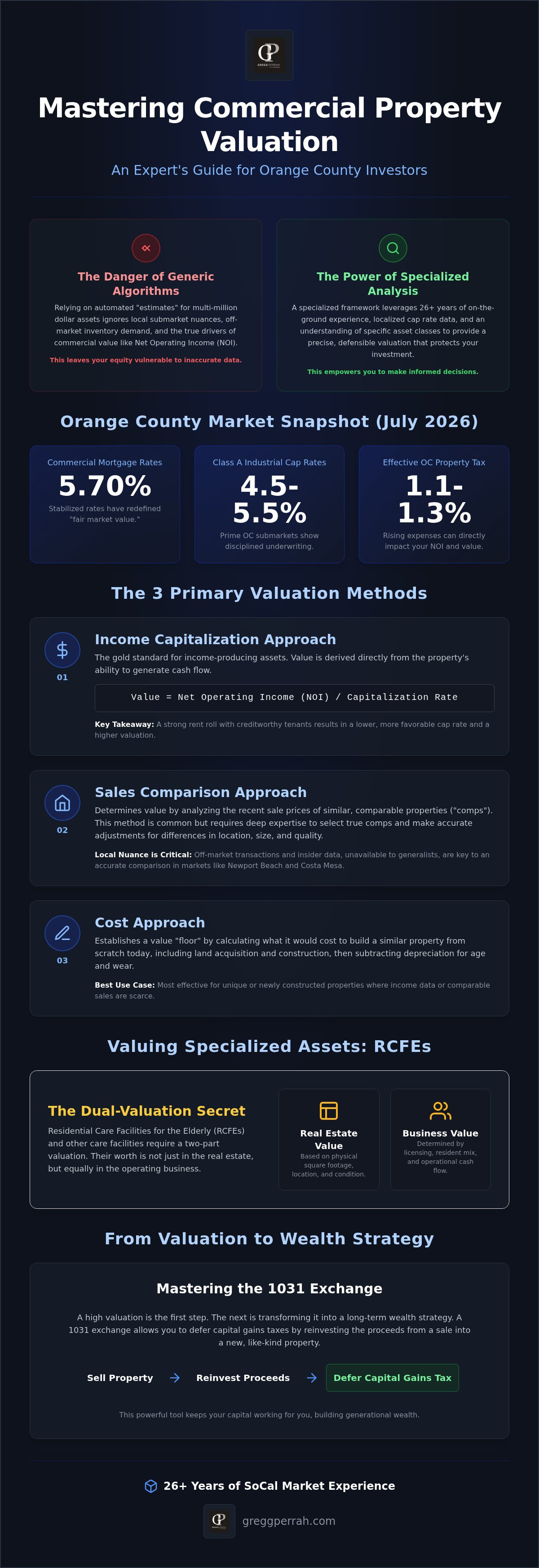
Why are you still trusting a generic algorithm to price a multi-million dollar asset in a market as nuanced as Newport Beach? Automated tools ignore the heartbeat of the local submarket and the specific demand for off-market inventory. You know that a standard "estimate" won't cut it when commercial mortgage rates sit at 5.70% and Class A industrial cap rates have stabilized between 4.5% and 5.5%. You've worked too hard to leave your equity to chance or inaccurate data.
This guide will show you how to master commercial property valuation Orange County by leveraging 26 years of on-the-ground experience and specialized asset analysis. Whether you're looking for a precise dollar value for a medical office or a complex RCFE, you need a centralized resource that understands local nuances. We'll explore the 2026 submarket trends in Costa Mesa and Irvine, decode the latest tax liabilities under Proposition 13, and outline a 1031 exchange strategy that keeps your capital working. Stop guessing and start analyzing with the authority your portfolio deserves.
Key Takeaways
- Stop using residential metrics for business assets; learn why OC’s 2026 market demands a specialized commercial valuation framework.
- Identify which of the three primary valuation methods—Income, Sales, or Cost—is the gold standard for your specific asset class.
- Master the "Coastal Premium" by understanding how submarket boundaries in Newport Beach and Costa Mesa impact your commercial property valuation Orange County.
- Uncover the dual-valuation secrets of RCFEs, where licensing and resident mix are just as critical as the physical square footage.
- Transform your high valuation into a long-term wealth strategy by mastering 1031 exchange deferrals for your capital gains.
Understanding Commercial Property Valuation Orange County Standards
Are you evaluating your commercial asset like it's a suburban house? That's a dangerous mistake. In the 2026 Orange County market, value isn't about curb appeal or what the neighbor's house sold for last month. It's about math, risk, and yield. Don't treat a retail strip in Costa Mesa like a three-bedroom home in Irvine. Residential appraisals rely on "comps" that often ignore the fundamental engine of a business asset: cash flow. For a precise commercial property valuation Orange County investors must pivot toward Net Operating Income (NOI). This figure represents your total income minus operating expenses. It's the single most important lever in your valuation.
In July 2026, we've seen commercial mortgage rates stabilize around 5.70%. This stabilization has ended the "shock mode" of previous years, but it has also redefined what constitutes "fair market value." Investors are now prioritizing disciplined underwriting and defensive assets over speculative growth. NOI isn't just a number on a spreadsheet; it's the heartbeat of your investment. We calculate this by looking at effective gross income minus every operating expense from property taxes to maintenance. If your expenses are creeping up due to the 1.1% to 1.3% effective tax rates in some OC districts, your value could be slipping. You need to know these numbers before you hit the market.
The Core Components of Commercial Value
Commercial value is a balance between what it costs to build and what it earns. While physical replacement cost provides a floor for value, the income potential almost always dictates the ceiling. You must look at the quality of your tenants. Is your building anchored by a credit tenant with a long-term triple-net (NNN) lease, or are you dealing with month-to-month local start-ups? The risk profile of that income stream determines your cap rate. Understanding Commercial Property Valuation Standards requires looking beyond the bricks and mortar to the strength of the paper attached to them. In 2026, Market Value for Orange County commercial assets is the most probable price a property commands in an open market, strictly adjusted for localized cap rate stability and the prevailing 5.70% cost of capital.
Why 'Generalist' Appraisals Fall Short
Stop relying on national data providers who have never stepped foot in Huntington Beach. National averages are useless when you're trying to price a specific industrial park with a 4.5% vacancy rate. You need the "Gregg Perrah" approach. With over 26 years of tenure in the SoCal market, I've seen how off-market data drives closing prices. In Newport Beach and Costa Mesa, the real market often moves behind closed doors. You need an insider who has been active since 1997 to interpret these non-public signals. Don't settle for a generic report. Demand a valuation that reflects the actual transactional pulse of the street. Accurate commercial property valuation Orange County hinges on localized, high-level negotiation experience that generalists simply cannot provide.
The 3 Primary Methods for Valuing OC Commercial Real Estate
Why guess when you can calculate? Determining the right commercial property valuation Orange County requires a multi-faceted strategy. You can't rely on a single data point or a generic appraisal. Instead, sophisticated investors utilize the 3 Primary Methods for Valuing OC Commercial Real Estate: Income, Sales Comparison, and Cost approaches. Each method serves a specific purpose depending on whether you're holding a stabilized retail center in Costa Mesa or a vacant industrial warehouse in Huntington Beach. You need to know which tool to pull from the belt to ensure your equity is protected.
The Income Capitalization Approach (Cap Rates)
This is the gold standard for income-producing assets like multifamily or retail. You calculate the Net Operating Income (NOI) by stripping away all operating expenses, but excluding debt service or depreciation. In July 2026, Class A industrial assets in prime OC submarkets are trading at cap rates between 4.5% and 5.5%. If you're in a high-demand area like Costa Mesa, your cap rate will be tighter than in less dense regions. Higher risk always demands a higher cap rate to offset the uncertainty. We look at the strength of your rent roll and the creditworthiness of your tenants to determine if your asset deserves a premium valuation.
The Sales Comparison and Cost Approaches
The Sales Comparison approach is about finding "True" comps. Don't just look at price per square foot. Look at the parking ratios and proximity to the 405 or 55 freeways. With the overall industrial vacancy rate at a tight 4.5% in mid-2026, these localized factors move the needle more than building age. The Cost Approach is mandatory for new construction or specialized assets like RCFEs where market comps are scarce. It calculates what it would cost to rebuild the structure from scratch today, minus depreciation. If you want to see how these methods apply to your specific portfolio, you should request a professional investment property analysis today.
Finding a "reconciled" value means weighing these methods against each other to find the most probable price. If the Income approach suggests $5 million but Sales Comparison shows $4.2 million, you have to ask why. Is the asset over-performing its market, or is the land value in Newport Beach simply that high? Mastering commercial property valuation Orange County involves pulling from institutional data like CoStar. However, we always verify those numbers against our own 26 years of non-public transaction history. This insider knowledge ensures your final number isn't just a mathematical average, but a reflection of real-world buyer appetite.
Orange County Submarket Trends: Newport Beach to Costa Mesa
Submarket boundaries in Orange County aren't just lines on a map. They're the difference between a 4% and a 6% yield. If you're performing a commercial property valuation Orange County, you must understand that the "Coastal Premium" is real and persistent. In mid-2026, we see Class A multifamily and industrial assets in prime submarkets trading at cap rates between 4.5% and 5.5%. Even with commercial mortgage rates hovering near 5.70%, the demand for coastal position remains aggressive. Why? Land scarcity in high-density zones creates a value floor that inland markets simply cannot replicate. You aren't just buying a building; you're buying a finite piece of the California coast.
Newport Beach and Coastal Asset Nuances
Coastal assets are trophy assets. In Newport Beach and Huntington Beach, land value often outstrips improvement value by a significant margin. This creates a unique dynamic where the building's physical age matters less than its footprint. If you're tracking Newport Beach Real Estate Listings, you'll see that buyers pay for the "trophy" status. This prestige keeps cap rates compressed even when the broader economy feels the squeeze. We analyze the specific "Coastal Premium" to ensure your valuation reflects the scarcity of the dirt, not just the rent roll.
Costa Mesa and Industrial Opportunity
Costa Mesa is currently the epicenter of an industrial resurgence. The desperate demand for "last-mile" delivery hubs has turned older warehouse stock into high-yield gold. With the overall OC industrial vacancy rate sitting at a tight 4.5% in the second quarter of 2026, competition for these spaces is fierce. You can find high-performing Commercial Property for Sale Costa Mesa that benefits from immediate proximity to affluent coastal consumers. Zoning changes near Northgate Market areas are also opening up new long-term plays for savvy investors. Are you positioned to capitalize on these shifts before the market fully prices them in?
What about the Irvine office market? In 2026, office valuation is a tale of two cities. High-quality Class A assets with long-term tenant commitments are showing resilience. Conversely, speculative developments and Class C spaces are under immense pressure from the hybrid-work model. Investors are applying strict underwriting discipline here, prioritizing cash flow over appreciation. If your asset doesn't demonstrate stable tenant demand, its valuation will reflect that elevated risk. Don't let a generalist guess your property's worth. With 26 years of tenure in these specific streets, we know the off-market demand that generic reports miss. Get a commercial property valuation Orange County that understands the difference between the Newport coast and the Irvine business district.
Valuing Specialized Assets: RCFEs and Care Facilities
RCFEs (Residential Care Facilities for the Elderly) are the most misunderstood asset class in Southern California. Many brokers treat them like standard residential flips. That's a mistake that costs you hundreds of thousands. A true commercial property valuation Orange County for a care facility requires a dual-track analysis. You're valuing the real estate and the business operations simultaneously. Are you looking at the bed count, the resident mix, or the licensing status? Each of these factors moves the needle on your final price. If you don't account for the specialized nature of the income, you're leaving money on the table.
Gregg Perrah's Specialized Senior Real Estate Specialist (SRES) designation isn't just a title. It's a lens through which we view facility-based assets. Since 1997, I've navigated the specific regulatory hurdles that define this niche. We don't just look at square footage. We look at the "Blue Sky", the intangible value of a well-run operation with a high-quality resident mix and a clean licensing history. Failing to account for these operational nuances is one of the most common pitfalls in valuing assisted living properties in Orange County.
The Business Valuation Component
In the RCFE world, EBITDA is king. While traditional commercial assets focus on NOI, a care facility's value is heavily tied to its operational earnings. If your facility is out-of-compliance or has a high staff turnover, your valuation will plummet regardless of the real estate's condition. You must analyze the licensing and regulatory history to protect your investment. Are the resident agreements up to date? Is the facility's bed count maximized under current zoning? These are the questions that determine your true exit price. For a deeper dive into the acquisition process, check out our RCFE for Sale Strategic Guide.
Investment Analysis for Senior Housing
Orange County's demographics are shifting toward an older, wealthier population. This creates a high-floor demand for senior housing, making it one of the most defensive plays in the 2026 market. However, the best opportunities never hit the public market. Success in the RCFE market depends entirely on accessing non-public inventory where the business and real estate are sold as a cohesive, profitable unit. Don't fall into the trap of overpaying for "potential" that isn't backed by bed-count math and actual resident income. You need to evaluate the facility's reputation and its ability to maintain high occupancy in a competitive landscape.
Ready to see what your facility is actually worth in today's market? You need an expert who understands the intersection of senior care and high-stakes real estate. Contact Gregg Perrah today for a specialized RCFE business valuation and get the insider clarity your portfolio deserves.
Maximizing Your Valuation: 1031 Exchanges and Disposition
What good is a high commercial property valuation Orange County if you lose a third of your gains to capital gains tax? A high number on a report is just the start. Real wealth isn't about the sale price; it's about what you keep. In the 2026 market, where commercial investment volume has surpassed $6.2 billion, the stakes for your exit strategy have never been higher. You need a disposition plan that protects your equity through a strategic 1031 exchange. Don't let a successful sale turn into a massive tax liability. Plan your next move before you ever plant a "For Sale" sign on the property.
Strategic timing is everything. With commercial mortgage rates stabilizing at approximately 5.70% in July 2026, the window for aggressive disposition has reopened. Investors are hungry for defensive assets, especially industrial and medical office spaces. If your valuation is at a peak, now is the time to leverage that equity into a higher-performing asset. We facilitate the entire transition, ensuring you move from a high-maintenance property into a streamlined, high-yield investment without missing a beat. Experience matters when you are navigating the complex intersection of market cycles and tax law.
Facilitating the 1031 Exchange
The rules for 1031 exchanges remain fully intact in 2026. You still have exactly 45 days to identify a replacement property and 180 days to close the transaction. That clock is relentless. Do you have a list of 'Like-Kind' assets ready to go? If not, you are gambling with your capital gains deferral. We specialize in identifying non-public, off-market inventory across Southern California that meets your specific investment criteria. Working with a broker who understands both the valuation of your current asset and the acquisition of your next one is the only way to ensure a seamless exchange. Don't wait until day 44 to start your search.
Next Steps: Get Your Professional Valuation
Do you need a formal appraisal or a Broker Price Opinion (BPO)? A formal appraisal is a bank-mandated requirement often costing upwards of $2,600 for a fixed-fee report. A BPO is a real-world, high-energy assessment of what a buyer will actually pay today. In a fast-moving OC market, the BPO is often more accurate because it accounts for immediate demand in Newport Beach and Costa Mesa that algorithms miss. You need a centralized resource center that stays "always-on" to capture these market shifts. Stop wondering what your asset is worth and get a precise commercial property valuation Orange County from a veteran with 26 years of local tenure.
Your equity is too valuable to leave to chance. Are you ready for a clear, dollar-for-dollar breakdown of your property's current standing? Contact Gregg Perrah for a confidential commercial property analysis and take the first step toward a high-conversion disposition strategy today.
Secure Your Equity in the 2026 Orange County Market
Do you want to leave your portfolio's future to a generic report? In 2026, the Orange County market demands more than surface-level math. You've seen how localized cap rate stability and submarket boundaries in Newport Beach and Costa Mesa redefine your property’s worth. You understand that specialized assets like RCFEs require a dual-track business and real estate analysis. Most importantly, you know that a high valuation is only as good as the 1031 exchange strategy that follows it. Success in this competitive landscape requires an insider's edge.
Gregg Perrah provides exactly that. With 26+ years of local real estate expertise and specialized RCFE and investment analysis, we offer more than just numbers. We give you access to exclusive non-public inventory and the high-level negotiation skills required to close. Don't settle for a guess when you can have a precise commercial property valuation Orange County backed by decades of transaction history. It's time to stop reacting to the market and start leading it. Your next big move starts with the right data. Let's get to work.
Unlock the True Value of Your Asset: Request a Professional Valuation from Gregg Perrah
Frequently Asked Questions
How often should I have my Orange County commercial property valued?
You should aim for a professional valuation at least once a year or whenever you're considering a 1031 exchange. Market conditions in Southern California move fast. An annual review ensures you aren't sitting on stagnant equity while the market peaks. It's the best way to stay proactive with your portfolio management.
What is the average cap rate for retail property in Costa Mesa in 2026?
In July 2026, Class A retail properties in prime Costa Mesa submarkets are seeing cap rates between 4.5% and 5.5%. These rates have stabilized alongside interest rates. High-demand, grocery-anchored centers often command the tightest yields due to their defensive nature. You need to look at specific tenant credit to find your exact number.
Does a 1031 exchange apply to RCFE business sales or just the real estate?
A 1031 exchange applies strictly to the real estate portion of the transaction. It does not cover the sale of the business operations or personal property. When selling an RCFE, we bifurcate the value between the physical asset and the "Blue Sky" business value. This ensures you maximize your tax deferral on the property while handling the business sale correctly.
How do interest rates specifically impact commercial valuations in Newport Beach?
Interest rates act as the primary anchor for cap rates. When commercial mortgage rates sit at 5.70%, buyers demand higher yields to ensure a positive spread. Newport Beach properties often resist dramatic value drops because of land scarcity. However, your debt-service coverage ratio will always be the ultimate gatekeeper for a buyer's offer price.
What documents do I need to provide for an accurate commercial valuation?
You'll need to provide updated rent rolls, three years of profit and loss statements, and all current lease agreements. Don't forget your most recent property tax bill and a list of any capital improvements made since 1997. For specialized assets, we also require licensing documentation and resident mix details to build a comprehensive income model.
Can I use a residential agent to value my commercial investment property?
You should avoid using a residential generalist for a commercial property valuation Orange County. Commercial assets are valued based on income potential and risk, not just comparable square footage. A residential agent won't have the tools to analyze NNN leases or cap rate compression. You need a veteran negotiator who understands institutional underwriting.
What is the difference between an RCFE and a standard assisted living facility for valuation purposes?
The main difference lies in the regulatory framework and the residential nature of the real estate. RCFEs are typically smaller facilities where the business value is inextricably linked to the home's footprint. Standard assisted living facilities are institutional. We value RCFEs by looking at the bed count and the specific resident income streams unique to the OC market.
How long does a professional commercial property valuation take in Orange County?
A professional commercial property valuation Orange County usually takes 3 to 7 days to complete via a Broker Price Opinion. If you require a formal, certified appraisal for a lender, expect a timeline of 2 to 4 weeks. We pride ourselves on immediate response times to help you move quickly in a competitive market. Speed matters when a 1031 exchange deadline is looming.


