

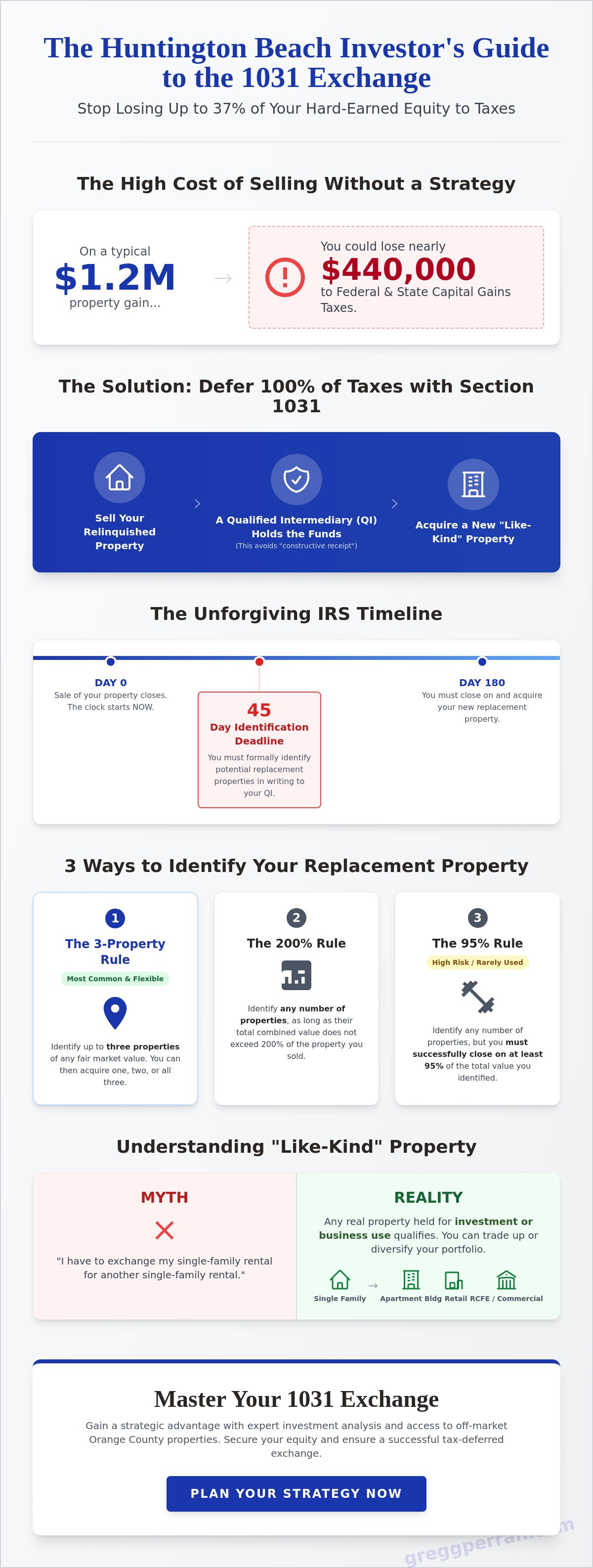
Selling your Huntington Beach investment property without a solid exit strategy is the fastest way to lose nearly 37% of your equity to federal and state taxes. Why hand over a massive chunk of your hard-earned profit to the IRS when you could reinvest every dollar into a higher-yielding asset? You've spent years building your portfolio; the anxiety of navigating the 1031 exchange rules Huntington Beach demands is completely justified. Between the strict 45-day identification window and the complex California clawback rules, one small mistake can trigger a massive tax event that wipes out your gains.
I understand the pressure of the 180-day closing clock and the confusion surrounding like-kind requirements, especially for investors transitioning from RCFE businesses into passive real estate. This guide is your roadmap to mastering these IRS requirements and securing your Southern California equity for the long haul. You'll learn exactly how to defer 100% of your capital gains taxes while upgrading to a more profitable or less management-intensive property. We're diving into the 2026 identification deadlines, the impact of current mortgage rates, and the specific strategies you need to win in this competitive Orange County market.
Key Takeaways
- Stop the 37% tax bleed by utilizing Section 1031 to keep your Southern California equity fully invested and growing.
- Lock in your replacement property within the critical 45-day identification window to avoid a massive, immediate tax event.
- Learn how the 1031 exchange rules Huntington Beach investors follow allow for swapping residential units for RCFE facilities or commercial assets.
- Eliminate the risk of "boot" or constructive receipt by utilizing a veteran Qualified Intermediary and professional investment property analysis.
- Gain immediate access to non-public inventory and off-market opportunities to secure your replacement property before the 180-day clock runs out.
Understanding 1031 Exchange Rules in Huntington Beach
Why would you hand the government nearly 40% of your hard-earned equity? In a market where the median home price has hit $1.4 million, the 1031 exchange rules Huntington Beach investors must follow are your only defense against massive capital gains taxes. Under the Internal Revenue Code Section 1031, you can defer both federal and California state taxes by "exchanging" your relinquished property for a replacement asset of equal or greater value. This isn't a tax loophole. It's a sophisticated reinvestment strategy designed to keep your capital working for you. With Huntington Beach property values seeing consistent year-over-year growth, failing to use this tool is a massive financial mistake.
Many investors believe "like-kind" means you must swap a condo for another condo. That is a myth. The IRS definition is incredibly broad. You can trade a single-family rental for an apartment complex, a retail storefront, or even specialized RCFE facilities. As long as it's real property held for investment or business use, it qualifies. However, you cannot touch the sale proceeds. You must use a Qualified Intermediary (QI) to hold the funds. If that cash hits your personal bank account for even one second, the exchange is dead. The IRS calls this "constructive receipt," and it triggers an immediate tax bill.
The Financial Power of Tax Deferral in Orange County
Think about the math on a $2 million Huntington Beach property. If you bought it years ago for $800,000, you're looking at a $1.2 million gain. Between federal rates, the Net Investment Income Tax, and California's aggressive state tax, you could lose over $440,000 to the taxman. That's nearly half a million dollars in lost purchasing power. By following the 1031 exchange rules Huntington Beach requires, you keep that $440,000 in your pocket. You can use it as a down payment on a $5 million asset instead of settling for a $3 million one. Which portfolio would you rather own?
Who Qualifies for a 1031 Exchange?
This strategy is for serious investors, not flippers or homeowners. Your property must be "held for productive use in a trade or business or for investment." This means your primary residence doesn't count; that falls under Section 121 rules. The IRS looks closely at your intent. Did you buy the property to generate income, or did you buy it just to sell it quickly? If you've held the asset for at least one to two years and have the paper trail to prove it, you're in the clear. Don't leave your wealth to chance. Secure your equity with expert investment property analysis today.
The Strict 1031 Exchange Timeline: 45 and 180-Day Deadlines
The IRS is not your friend. They don't care if you're sick, if the market is tight, or if your lender drags their feet. Once you close the sale of your Huntington Beach property, the clock starts. You have exactly 45 calendar days to identify your replacement assets. This is the most intense period of your investment career. If you miss this deadline by one minute, your exchange fails. You'll owe the IRS every penny of that deferred tax. Many investors realize too late that understanding the 1031 exchange rules and basics is just the starting point. You need a tactical plan before your relinquished property even hits the market.
Are you prepared for Day 46? If you haven't identified your targets in writing to your Qualified Intermediary, it's over. The 1031 exchange rules Huntington Beach investors face are unforgiving. Start your search early. Use a veteran network to access non-public inventory. Why wait for the clock to start when you can win the race before it begins? Successful investors often have their replacement property under a non-binding letter of intent before they even close their sale.
Rules for Identifying Replacement Properties
How do you choose your targets? You can't just list every property in Orange County. You must follow one of three strict IRS identification rules:
- The 3-Property Rule: Identify up to three properties of any value. This is the most common path.
- The 200% Rule: Identify any number of properties, but their combined fair market value cannot exceed 200% of the property you sold.
- The 95% Rule: Identify as many as you want, but you must actually close on at least 95% of the total value identified. This is extremely risky and rarely used.
Managing the 180-Day Closing Window
You have 180 total days to close on your new asset. This period includes the first 45 days. Don't let the 180-day number fool you. Between inspections, appraisals, and complex financing, time disappears. If you sold your property after October 16, 2025, listen closely. Your 180-day window might actually end on April 15, 2026. Why? Because the exchange period cannot extend past your tax return due date. You must file a formal tax extension to get the full 180 days. This is where expert 1031 exchange facilitation saves your equity from a preventable disaster. One missed filing or a slow escrow officer can cost you hundreds of thousands in capital gains taxes. Do you have the right team watching the calendar for you?
Identifying "Like-Kind" Property in the Southern California Market
Stop thinking small. Many investors believe they must replace a beach cottage with another beach cottage. That is a costly misconception. The 1031 exchange rules Huntington Beach mandates are actually liberating. You can trade that high-maintenance rental for a medical office, a strip mall, or a specialized care facility. The IRS only requires that the assets be held for productive use in a trade or business. This flexibility allows you to pivot your entire investment strategy without losing a dime to capital gains. Are you maximizing your equity, or are you just recycling the same low-yield assets?
The "like-kind" umbrella covers everything from raw land to multi-family apartment buildings. In a competitive market like Orange County, where the median home price hit $1.4 million in May 2026, staying in the residential sector might not always be your best move. Why stay stuck in a 1.2% growth cycle when you can exchange into a higher-performing asset class? You have the right to diversify. Use it.
Exchanging into RCFE and Senior Care Facilities
Huntington Beach is a prime location for senior care investments. Have you considered an RCFE? These facilities offer incredible cash flow, but the exchange process is technical. You must separate the business valuation from the real estate value. Only the real property qualifies for the tax deferral. If you are looking for an RCFE for sale, you need a veteran who understands the nuances of facility-based assets. This is where professional investment property analysis becomes your most valuable tool. Don't let a sloppy valuation trigger an IRS audit.
Commercial vs. Residential: Strategic Shifts
Are you tired of "toilets and tenants"? Many aging portfolios are shifting toward passive income. You can consolidate three smaller Huntington Beach condos into one high-performing commercial asset. Look at the commercial property for sale Costa Mesa offers right now. Transitioning into a Triple Net (NNN) lease means the tenant pays the taxes, insurance, and maintenance. You just collect the check. This is how you secure your Southern California equity while reclaiming your time. Don't settle for low yields when the market allows for such powerful strategic moves. Get the insider access you need to find these off-market opportunities before they hit the general public.
Common Pitfalls: Why Huntington Beach Investors Lose Tax-Deferred Status
Think you've followed the rules? You hit the deadlines. You found a like-kind property. But you still get a massive tax bill. How? You likely fell into the "boot" trap. The 1031 exchange rules Huntington Beach investors must navigate are riddled with these hidden landmines. If you walk away from a closing with cash in your pocket or a smaller mortgage on the new property, the IRS considers that a taxable gain. You must reinvest every cent of the net equity and replace every dollar of debt. There are no shortcuts here. One small slip in your math can trigger a tax event that wipes out your entire strategy.
Another common disaster is "constructive receipt." If the sale proceeds from your relinquished property hit your personal bank account for even one second, the exchange is dead. You cannot touch the money. You cannot even have the "right" to touch the money. This is why your choice of partner is critical. Furthermore, the name on the deed of your new property must match the old one exactly. If your LLC sold the asset, your LLC must buy the replacement. Changing the title to your personal name mid-stream is a guaranteed way to void your tax-deferred status. Don't let a clerical error destroy decades of equity growth.
Cash Boot and Mortgage Boot Explained
To achieve 100% tax deferral, you must "buy up" in value. If you sell a Huntington Beach duplex for the median price of $1.4 million but only buy a replacement for $1.2 million, that $200,000 difference is "cash boot." You will pay taxes on it. The same applies to your debt. If your old property had a $500,000 mortgage and your new one only has a $400,000 loan, the $100,000 reduction is "mortgage boot." It's treated as taxable income. To avoid this, you must either take on more debt or bring your own personal cash to the table to bridge the gap. Precision is the only way to protect your capital.
The Critical Role of the Qualified Intermediary
You cannot act as your own intermediary. Neither can your buddy, your regular CPA, or your family attorney. The IRS requires an independent Qualified Intermediary (QI) to facilitate the trade. They hold your funds in a secure, segregated account and prepare the legal documentation required for an audit. In a high-stakes market like Orange County, you need a QI who understands the speed of local transactions. Relying on the MLS is a Day 46 disaster because Huntington Beach currently has a tiny 1.03-month supply of inventory. You need a team that secures off-market deals before the clock even starts. Stop guessing and start winning by getting a professional investment property analysis to identify your "boot" risks before you list.
Strategic Reinvestment: Leveraging Local Expertise for Your Next Move
Success in a 1031 exchange isn't about finding a property on a public website. It's about who you know before that property ever hits a search engine. In a market where inventory is sitting at a razor-thin 1.03-month supply, waiting for the MLS is a losing strategy. The 1031 exchange rules Huntington Beach investors face are strict, but local market access is the ultimate equalizer. Gregg Perrah’s 26+ years of tenure in Southern California provides the keys to a centralized resource center. This isn't just a brokerage; it's a hub that connects you with vetted Qualified Intermediaries, specialized CPAs, and aggressive commercial lenders who understand investment math.
Why settle for a generic service? You need luxury real estate agents who prioritize fiscal clarity over global branding. We specialize in identifying non-public, off-market opportunities that give you a massive advantage during your 45-day identification period. This proactive approach turns a high-stress race against the clock into a calculated, professional transition. We don't just find you a property; we secure an asset that aligns with your long-term wealth goals.
Huntington Beach Market Trends for 2026
The 2026 cycle is favoring stability over speculation. While the median home price in Huntington Beach has reached $1.4 million, savvy investors are looking toward high-yield, resilient assets. Senior-focused downsizing and RCFE facilities are outperforming traditional residential rentals in cash-on-cash returns. Are you looking to upgrade your legacy? Many of our clients are shifting equity into Newport Beach real estate to capture long-term appreciation in premium coastal pockets. These moves require precision and a guide who has navigated every market cycle since the late 1990s. We know which neighborhoods are poised for growth and which ones have peaked.
Your 1031 Action Plan: Get Started Today
Don't wait until you're in escrow to build your team. The clock is your enemy, and the IRS won't give you a head start. Follow these steps to secure your wealth:
- Step 1: Request a comprehensive investment property analysis to determine your exact net equity and potential boot risks.
- Step 2: Review our exclusive, non-public inventory to find your replacement property before you list your current asset.
- Step 3: Execute your exchange with the confidence of a 26-year veteran behind you.
Ready to protect your equity? Ask Gregg Perrah for a 1031 consultation right now. We're available to start your analysis immediately and ensure your Southern California portfolio stays on the right side of the tax code.
Secure Your Southern California Equity Today
You've spent years building your real estate portfolio. Don't let the IRS take nearly 40% of your profit because of a missed deadline or a simple math error. Mastering the 1031 exchange rules Huntington Beach requires is about more than just reading the tax code. It's about having a tactical plan that starts before your property even hits the market. You've seen how the 45-day identification window can make or break your exchange. You also know that like-kind definitions open doors to high-yield RCFE businesses and passive commercial assets that can transform your financial future.
Why navigate this high-stakes process alone? Gregg Perrah brings over 26 years of local market experience and a Senior Real Estate Specialist (SRES) designation to your side. As an expert in RCFE sales and non-public inventory, he provides the insider access you need to beat the 180-day clock. Stop worrying about boot or constructive receipt and start focusing on your next move. Your equity is your legacy. Let's protect it together.
Get Your Free 1031 Exchange Property Analysis from Gregg Perrah
Frequently Asked Questions
Can I do a 1031 exchange on my primary residence in Huntington Beach?
No, you cannot. Section 1031 is reserved strictly for properties held for productive use in a trade or business or for investment purposes. If you are selling the home you live in, you should explore Section 121, which allows for different tax exclusions on the sale of a principal residence. Don't confuse the two; using the wrong tax code can lead to a massive bill from the IRS.
What happens if I identify a property but cannot close within 180 days?
Your exchange fails, and the deferred taxes become due immediately. The IRS is famously unforgiving regarding the 180-day window. They don't care about slow lenders, difficult sellers, or inspection delays. If you don't close on your identified replacement property by the deadline, you'll owe capital gains taxes on your original sale. This is why having a veteran guide to push the escrow process forward is essential.
Can I sell a rental house and buy an RCFE business using a 1031 exchange?
You can exchange the real estate, but the business assets are treated differently. The 1031 exchange rules Huntington Beach investors must follow only apply to real property. When buying an RCFE, you must work with an expert to separate the value of the land and building from the business goodwill and equipment. Only the real estate portion qualifies for tax deferral; the rest is a taxable event.
How much does a Qualified Intermediary (QI) cost in Orange County?
Fees for a Qualified Intermediary vary based on the complexity of your exchange and the number of properties involved. Since these are third-party service providers, you should request a specific quote based on your transaction's needs. Don't shop for the lowest price; shop for the highest security. Your QI will be holding your entire net equity, so choose an entity with a proven track record and strong insurance coverage.
Can I use a 1031 exchange to buy property for my children to live in?
Not if their residency is the primary intent of the purchase. The IRS requires you to hold the replacement property for investment or business use. If your children pay full fair market rent and you manage the property as a legitimate rental business, it might qualify. However, you're playing with fire if the IRS suspects the property is for personal use. Always get a professional investment property analysis before attempting this strategy.
What is "boot" and how do I avoid paying taxes on it?
"Boot" is any non-like-kind value you receive in an exchange, such as cash or a reduction in your mortgage debt. To avoid paying taxes on boot, you must reinvest 100% of your net sales proceeds and replace the entirety of your old mortgage on the new property. If you "trade down" in value or debt, the difference is considered taxable gain. Always aim to buy equal or greater in value to stay fully deferred.
Do 1031 exchange rules differ for commercial vs. residential property?
No, the core rules are identical. The IRS considers all real property held for investment to be "like-kind" with each other. This flexibility is a powerful tool for your portfolio. You can sell a high-maintenance residential fourplex and exchange it for a passive NNN commercial lease or a retail center. The asset class doesn't matter as much as your intent to hold it for investment.
Can I sell a property in another state and buy in Huntington Beach?
Yes, federal 1031 rules allow you to exchange real estate anywhere within the United States. Selling a low-growth asset in the Midwest to capture the equity gains in Southern California is a common move. Just be mindful of the tax laws in the state where you sold the property. Some states have "clawback" provisions that may require you to file annual reports until the new property is eventually sold.


