

Is your attic holding your home's market equity hostage? Most homeowners spend years paralyzed by the emotional weight of "stuff," yet they fail to realize that every box of old files or unused furniture is a barrier to their next big investment. You know the feeling of exhaustion that hits just by looking at a closet. You worry about throwing away a hidden gem or feeling guilty for donating a family heirloom. It's a heavy burden, but it doesn't have to be your reality.
You deserve a clear, strategic roadmap to reclaim your space and your sanity. This article teaches you exactly what to do with a lifetime of belongings before moving by applying high-level asset management principles to your personal property. We're moving past the "cleaning" phase and into a pro-level plan that maximizes your time and your bottom line.
We'll preview the 2026 tax implications for your donations, identify which collectibles are worth the 28% capital gains tax, and show you how to secure the best return on your transition. Stop the analysis paralysis today. Follow this checklist to turn your lifetime of memories into a streamlined path forward.
Key Takeaways
- Apply the 90-day rule to transform your residence into a high-value product rather than a personal museum.
- Utilize a professional triage system to decide what to do with a lifetime of belongings before moving while identifying high-value collectibles.
- Deploy the Legacy Box method to preserve your history without the physical footprint, effectively ending sentimental guilt.
- Target high-volume areas like the garage and attic first to eliminate the hidden weight that inflates moving costs.
- Calculate your Clutter Tax and discover how strategic downsizing directly increases your home's market equity.
The Downsizing Mindset: Why Strategy Beats Sweat
Stop viewing your home as a sanctuary and start seeing it as an asset. When you're deciding what to do with a lifetime of belongings before moving, you must transition from a "museum" mindset to a "product" mindset. Buyers aren't looking for your memories; they're looking for their future. If your square footage is buried under decades of inventory, you're literally hiding money from yourself. Do you want to maximize your equity? Then you must be willing to liquidate the clutter that obscures your home's true value.
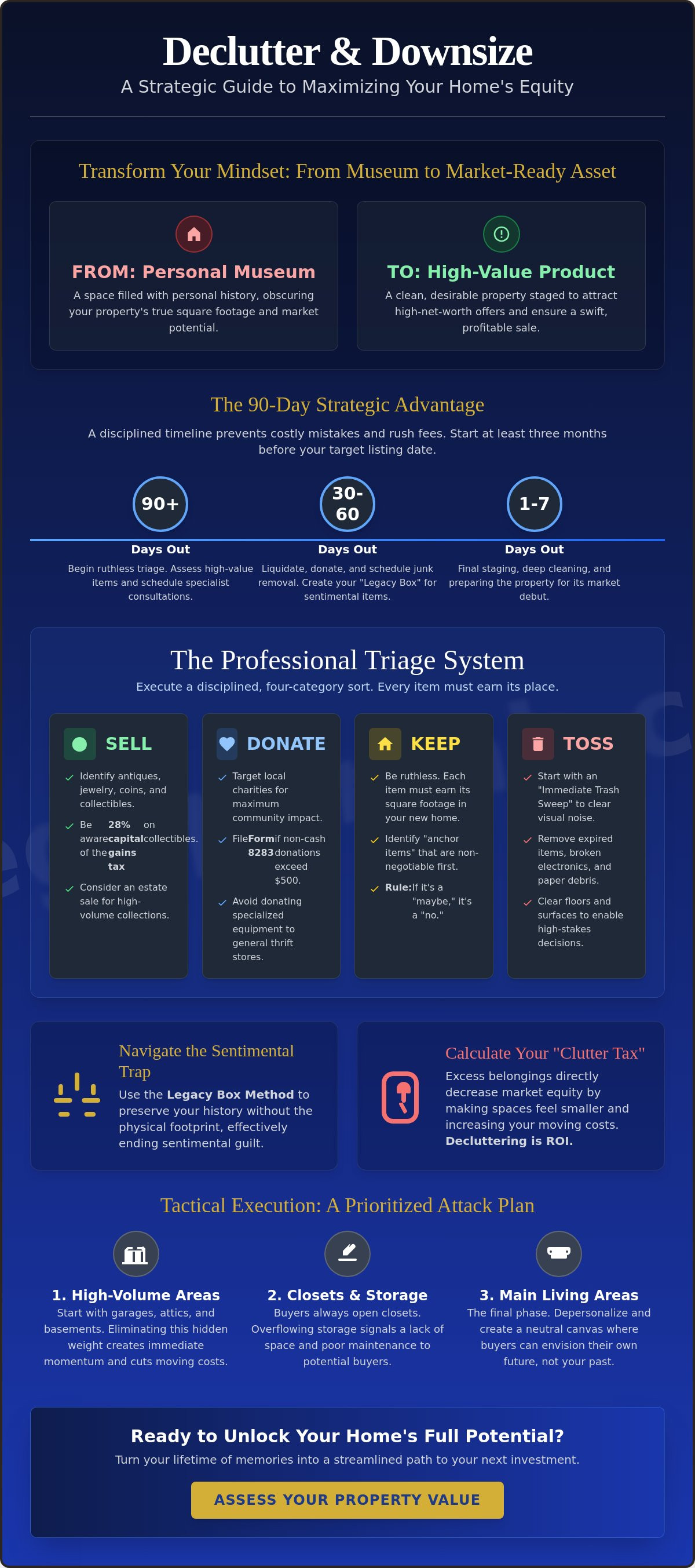
Success in this transition requires a strict 90-day lead time. You can't sort 30 years of history in a single weekend without making expensive mistakes. Start at least three months before your listing date to allow for systematic decluttering methods that maximize every room's visual appeal. This window gives you the tactical advantage to vet buyers for your collectibles and schedule junk removal without paying a "rush tax." Strategy always beats sweat in a high-stakes move.
Don't fall for the sunk cost fallacy. That heavy oak armoire might've cost a fortune in 1992, but if it's blocking a window or making a bedroom look cramped today, it's a liability. As a Senior Real Estate Specialist (SRES), I provide the professional clarity needed when determining what to do with a lifetime of belongings before moving. I help you identify which items add value and which ones are anchoring you to a stagnant listing. We simplify the transition by focusing on the financial outcome of the sale rather than the emotional weight of the objects.
Setting Your Real Estate Objectives
Define your goal immediately. Are you selling for top dollar or prioritizing a quick exit? This decision dictates how aggressively you purge. Identify your "anchor items" first; these are the non-negotiables that must fit into your next space. My vision for you is a lighter, high-velocity lifestyle where your assets work for you instead of you working for your assets.
The Perrah Perspective on Market Readiness
Empty space is a luxury. In the current market, a "full" home feels small, dated, and overwhelming. Clutter triggers a psychological red flag for buyers; they often assume the home hasn't been maintained if the closets are overflowing. If you're planning a 1031 exchange or a complex residential sale, this decluttering phase is your first step in asset repositioning. We ensure your property is "move-ready" to attract high-net-worth offers and clean, decisive transitions.
The Professional Triage System: Sell, Donate, Keep, or Toss
Don't let the clutter dictate your timeline. You need a ruthless triage system to separate the treasures from the trash. Deciding what to do with a lifetime of belongings before moving is an exercise in asset management. You're not just cleaning; you're preparing a product for the marketplace. Start with these four critical steps:
- Step 1: The Immediate Trash Sweep. Clear the visual noise. Grab heavy-duty bags and remove expired medications, broken electronics, and paper debris. You need clear floors to make high-stakes decisions.
- Step 2: The Market Value Assessment. Identify antiques, jewelry, and coins. Remember that net long-term capital gains on collectibles are taxed at a maximum federal rate of 28% in 2026. Is the item worth the tax and the effort to sell?
- Step 3: The Donation Strategy. Target local Orange County charities for maximum community impact. If your total non-cash donations for the year exceed $500, you must file Form 8283 to claim your deduction.
- Step 4: The Final Keep List. Be ruthless. Every item you keep must earn its square footage in your new home. If it's a "maybe," it's a "no."
The secondhand market has grown 127% compared to pre-pandemic levels. This means there's a massive opportunity to liquidate assets if you move quickly. If you're unsure about how your inventory affects your home's marketability, assessing your property's total value is a critical first step in your downsizing journey.
Identifying High-Value Assets
Should you call an estate sale professional or list on eBay? For high-volume collections, an estate sale is the most efficient exit strategy. Be realistic about "brown furniture" in the 2026 market. Heavy Victorian pieces often lack the liquidity of mid-century modern assets. If you're selling a property with RCFE-related equipment, these specialized assets require niche buyers. Don't donate specialized medical gear to general thrift stores. Seek out facility-based buyers who understand the replacement value of these niche investments.
Smart Donation and Disposal
Impact your community in Newport Beach and Costa Mesa by choosing charities that provide detailed tax receipts. For hazardous waste like old paint or garden chemicals, check your local regulations. California now has specific point-of-sale recycling fees for electronics with embedded batteries. Don't risk a fine by improper disposal. Schedule a bulk pick-up day with your waste management provider for large items that don't pass the donation test. It's the cleanest way to clear the deck before the movers arrive.
Navigating the "Sentimental Trap" Without the Guilt
Are you drowning in nostalgia? Sentimental items are the primary cause of analysis paralysis. When you're stuck deciding what to do with a lifetime of belongings before moving, you must separate your memories from your inventory. Objects aren't people. Your legacy isn't stored in a box of old greeting cards or a dusty attic. As a Senior Real Estate Specialist (SRES), I see homeowners lose thousands in potential home equity because they refuse to clear out "memory clutter" that turns off buyers. Stop letting your past hold your financial future hostage.
Implement the Legacy Box method immediately. Choose one specific physical container, like a decorative trunk or a standard storage bin. This is your boundary. You can keep anything that fits inside, but once it's full, the sorting stops. This forces you to prioritize the top 1% of your history. What about the rest? Give your heirs a "Family First" offer with a hard 30-day deadline. If they don't claim it and move it by the cutoff, it goes to the donation pile. Don't let your home become a free storage unit for adult children who likely don't want your fine china anyway. Modern buyers and heirs alike now prioritize experiences over physical inventory.
The One-Year Rule for Memories
Apply the logic of utility to your emotions. If you haven't opened a box in the last 12 months, do you really own those items, or do they own you? Distinguish between "I love this" and "I feel guilty tossing this." Guilt is a poor reason to pay for a larger moving truck. Consider hosting a "Memory Party." Invite loved ones over, share the stories behind the items, and let them take a piece of the history home. This redistributes your legacy while clearing your square footage for a high-value listing.
Professional Photo Archiving
Digital archiving is your secret weapon for what to do with a lifetime of belongings before moving. You can shrink an entire room of trophies, scrapbooks, and albums into a single, high-quality coffee table book. Utilize professional scanning services in Southern California that specialize in bulk media conversion. Why keep 20 heavy photo albums when a single digital frame can rotate through thousands of images in one square foot of space? Protect the memory. Liquidate the mass. This is how you transition to a lighter, more mobile lifestyle without losing your history.
Room-by-Room Execution: A Tactical Packing Checklist
Every box you pack is a bill you'll eventually pay. When deciding what to do with a lifetime of belongings before moving, you must evaluate every item by its weight and volume. In 2026, a local move can cost between $85 and $210 per hour for a two-person crew. Why pay professionals to haul items you haven't touched since the last market cycle? You aren't just packing; you're auditing your assets. If an item doesn't serve a clear purpose, it's a liability that inflates your moving costs.
Start in the closet with the "Reverse Hanger" trick. Turn all your clothes hangers backward. When you wear an item, return it to the rack with the hanger facing forward. After 30 days, any hanger still facing the wrong way identifies a candidate for the donation pile. This provides immediate, visual data on your actual needs versus your perceived needs. Be ruthless. If it doesn't fit your current OC lifestyle, it doesn't deserve a spot in your new square footage.
Move to the home office and shred the past. While you must retain vital tax records and RCFE business documentation, most paper archives are obsolete. Junk removal services in 2026 typically cost between $70 and $850 depending on the volume. Don't waste your budget on filing cabinets full of outdated invoices. A cleared, professional office space signals a well-maintained property to potential buyers. Are you ready to see how a streamlined home impacts your bottom line? Start planning your next residential sale with a professional valuation today.
The Kitchen and Pantry Purge
Eliminate the "unitaskers." Do you really need a dedicated egg cooker or three different blenders? Ditch the "good" china if it hasn't seen a dinner party in five years. Consolidate your plastic containers and immediately toss anything without a matching lid. Check the expiration dates in your pantry; spices and canned goods lose their value and flavor over time. A lean kitchen makes your cabinets look deeper and more appealing during a showing.
Garage and Outdoor Storage
The garage is the primary source of hidden weight. Evaluate your tools with a "stay or go" mindset. If you're moving to a smaller property, you won't need that heavy-duty commercial lawnmower or rusted garden equipment. Discard half-used bags of fertilizer and old chemicals at a local hazardous waste facility. Finally, perform a sports equipment reality check. If those skis haven't left the rafters in a decade, sell them now. The secondhand market is booming, and your unused gear is liquid capital waiting to be claimed.
Maximizing Equity: How Decluttering Funds Your Next Chapter
How much is your clutter costing you? Most sellers ignore the "Clutter Tax" until they see a low-ball offer. When you're deciding what to do with a lifetime of belongings before moving, you aren't just cleaning. You're recovering lost equity. A home packed with decades of inventory feels smaller, older, and overwhelmed. Buyers don't want to buy your work; they want to buy a finished product. Every box you remove adds perceived square footage and real dollars to your final offer. Don't pay a tax on your own hesitation.
Stop living in your home and start selling it. Transitioning from a residence to a high-value listing requires a clinical approach to staging. Use the capital generated from your liquidated assets to fund high-impact repairs. Did you sell that old coin collection or the "brown furniture" that doesn't fit your new lifestyle? Use those proceeds for fresh paint or modern light fixtures. These minor adjustments often yield a massive return on investment at the closing table. You're trading dust-collectors for a higher sale price.
Gregg Perrah | FirstTeam Real Estate uses 26 years of professional tenure to spot the hidden value in your estate when determining what to do with a lifetime of belongings before moving. I don't just see a house; I see a complex financial asset that needs optimization. My experience as a Senior Real Estate Specialist allows me to identify non-public opportunities that general practitioners miss. I've navigated every market cycle since the late 90s. I know exactly which items to keep for staging and which ones to liquidate to trigger a bidding war. Let's turn your inventory into an advantage.
The ROI of a Clean Slate
Why do luxury real estate agents insist on a total purge before the cameras arrive? The camera doesn't lie. High-end buyers in 2026 expect a gallery-like environment where they can envision their own future. Remember that for the sale of a primary residence in 2026, married couples filing jointly can exclude up to $500,000 of capital gains. You've worked decades for that equity; don't let a cluttered interior diminish your return. A clean slate sells faster and protects your hard-earned wealth.
Your Next Step in Orange County
Timing is everything in the OC market. Consult my Newport Beach real estate guide for the latest market insights and off-market secrets. Your downsizing journey is the perfect moment for a comprehensive asset valuation. Don't leave your equity to chance. Are you ready to move with confidence and clarity? Get a professional valuation of your home and assets today.
Secure Your Financial Future Today
You've mastered the mindset and the tactical triage. Now it's time to execute. Deciding what to do with a lifetime of belongings before moving is a strategic pivot that preserves your legacy while maximizing your home's market value. You've learned how to bypass the sentimental trap and audit your rooms with surgical precision. Don't let the momentum stop here. Every day you wait is another day your equity remains buried under inventory.
I bring over 26 years of Southern California real estate tenure to your kitchen table. As a certified Senior Real Estate Specialist (SRES), I've guided hundreds of families through complex RCFE transitions and high-stakes 1031 exchange facilitations. My mission is to turn your lifetime of accumulation into a streamlined asset ready for a record-breaking sale. You need an insider who knows how to spot hidden value in every square foot of your estate.
Are you ready to stop the analysis paralysis? Download My Exclusive Downsizing Checklist & Get a Free Home Valuation. Let's unlock the true potential of your property and prepare you for a seamless next chapter. You've done the hard work; let's finish the job together.
Frequently Asked Questions
How far in advance should I start decluttering before a move?
You should start decluttering at least 90 days before your listing date. This three-month window allows you to execute a systematic triage without the pressure of a looming deadline. It gives you the necessary time to vet estate sale professionals and coordinate with junk removal services. Starting early ensures your property reaches a "Move-Ready" state before the first photographer enters the home.
What items are actually worth selling at an estate sale in 2026?
High-demand assets like coins, jewelry, and mid-century modern furniture hold the most liquidity in 2026. Be aware that net long-term capital gains from selling collectibles are taxed at a maximum federal rate of 28%. Focus on items that have a verified market demand. Avoid spending energy on heavy Victorian pieces, which currently lack the resale velocity of more contemporary or specialized assets.
How do I handle my parents’ belongings when they are moving to an RCFE?
Prioritize the physical volume of the new facility when determining what to do with a lifetime of belongings before moving a parent to an RCFE. Use the Legacy Box method to limit sentimental items to a manageable size. As an expert in RCFE transitions, I recommend focusing on comfort and familiarity over quantity. Digitalize photos to preserve memories without occupying precious square footage in a care environment.
Are there local Newport Beach charities that offer furniture pick-up?
Several Orange County organizations provide pick-up services, but you must verify their current acceptance policies. Organizations like Goodwill have strict guidelines and typically do not accept mattresses, large appliances, or recalled items. Always secure a written acknowledgment for donations valued at $250 or more for your 2026 tax records. Contact local Newport Beach centers directly to schedule a bulk pick-up well in advance of your move.
Should I rent a storage unit during the decluttering process?
Renting a storage unit is usually a strategic mistake that acts as a "clutter tax" on your transition. Most people use storage to delay difficult decisions rather than solve them. Only utilize off-site storage for high-value staging furniture that you've already committed to keeping for your next residence. Otherwise, you're simply paying to house liabilities that should have been liquidated or donated months ago.
What are the most common things people regret throwing away?
Regret typically stems from discarding vital legal documents or irreplaceable family photos. Ensure you shred only the unnecessary paperwork while retaining tax records and RCFE-related business documents. Digitalize your entire photo library before you begin the physical purge. Most other physical objects are replaceable; your primary goal is to keep the memory and the legal protection while shedding the physical mass that slows your move.
How does decluttering affect my home appraisal or sale price?
Decluttering directly impacts your sale price by increasing the perceived square footage of every room. A clear, staged home allows potential buyers to focus on the architecture and the lifestyle rather than your personal history. When you're deciding what to do with a lifetime of belongings before moving, remember that every cleared closet makes your home look more maintained. Professional staging often leads to higher offers and faster closings.
Is it better to have an estate sale before or after listing the home?
Conduct your estate sale before you list the home for sale. You want the property to look like a high-value product, not a liquidation center, when buyers walk through the door. An empty or professionally staged home is far more appealing than one filled with price tags and browsing crowds. Complete the sale, clear the remaining inventory, and then launch your marketing campaign for maximum impact.