

Is the equity in your Newport Beach or Huntington Beach rental actually working for you, or are you just working for it? You've likely felt the squeeze of California's tightening rent caps under AB 1482 and the exhausting regulations that make landlording feel like a second full-time job. It's frustrating to watch your hard-earned equity sit stagnant while you dread the 3.33 percent mandatory state withholding or the "clawback" rules of Form 3840. Executing a 1031 exchange into rental property Orange County has never been more complex. The 45-day identification window closes faster than ever in our competitive local market. This often leaves investors panicked and prone to overpaying just to beat the clock.
You deserve a strategy that protects your wealth without the management headaches. I'll show you how to master these tax-deferred complexities to defer every cent of capital gains while significantly increasing your monthly cash flow. This guide breaks down the critical choice you face in 2026. We'll compare the hands-on grind of direct ownership in Costa Mesa against the streamlined, passive yield of Delaware Statutory Trusts. It is time to decide if you want to chase tenants or collect checks. Let's secure your legacy with a high-quality asset in a premium market.
Key Takeaways
- Identify why 2026 appreciation levels demand a proactive tax strategy to protect your equity from devastating state and federal liabilities.
- Compare the control of a 1031 exchange into rental property Orange County against the hands-off yield of institutional-grade DST investments.
- Navigate the high-stakes 45-day identification window using the Three-Property or 200% rules to secure your replacement asset without the stress.
- Leverage professional investment property analysis to determine if active landlording or passive fractional ownership fits your 2026 lifestyle goals.
- Partner with a 26-year local veteran to navigate complex 1031 transactions with the confidence of a market insider.
Why Orange County Investors Face a 1031 Exchange Crossroads in 2026
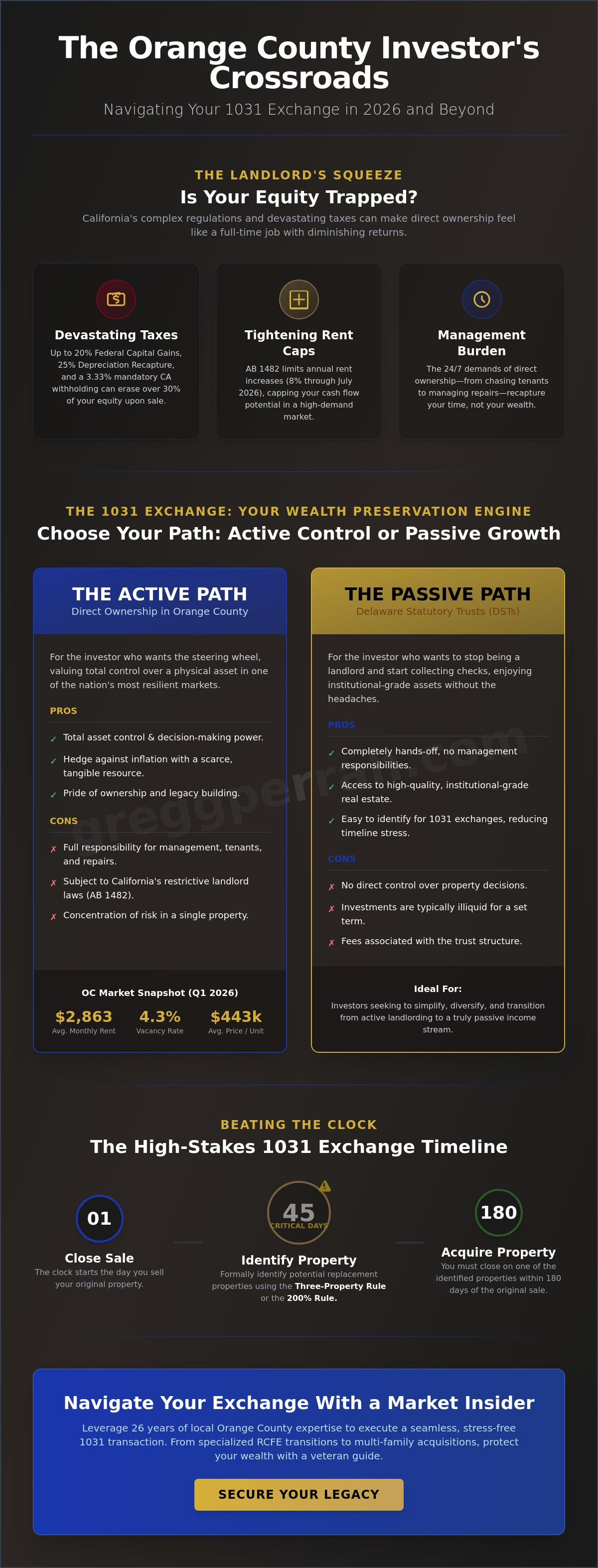
Your Orange County property has likely seen explosive appreciation over the last decade. With the average multifamily price per unit hitting $443,000 in early 2026, you're sitting on a mountain of equity. But here is the problem: that equity is trapped. If you sell today without a strategy, the tax hit will be devastating. This is why savvy investors utilize the Internal Revenue Code Section 1031. It is not just a tax loophole; it's a wealth-preservation engine that allows you to swap your high-maintenance or underperforming assets for something that actually fits your 2026 lifestyle. Are you ready to stop being a "landlord" and start being an "investor"?
A 1031 exchange into rental property Orange County provides the rare opportunity to pivot your portfolio without losing 30 percent or more of your profit to the government. Whether you are moving from a single-family home in Huntington Beach to a multi-unit complex in Costa Mesa, or transitioning from a high-intensity RCFE business into passive real estate, the goal is the same: defer the tax and compound your growth. You've spent decades building this network. Don't let a single transaction reset your progress.
The Cost of Doing Nothing: California Tax Exposure
Selling your property outright in California is a financial trap for the unprepared. You'll face a federal capital gains tax of up to 20 percent, plus a federal depreciation recapture tax at a flat rate of 25 percent. Think it ends there? It doesn't. California requires a mandatory withholding of 3.33 percent of the total sales price at the close of escrow, even if you plan to reinvest later. If you move your funds out of state, the California "clawback" rule and Form 3840 will follow you for years. The 'Like-Kind' rule allows investors to defer taxes by exchanging one investment property for another of a similar nature, regardless of quality or grade. Use this rule to keep your equity working for you instead of the Franchise Tax Board.
From RCFEs to Rentals: A Specialized Transition
Are you tired of the 24/7 operational demands of running a Residential Care Facility for the Elderly? Many OC owners are currently exiting the RCFE space to recapture their time. Transitioning from an active business sale into a standard residential or commercial rental requires a specialized approach to manage the valuation gap between the business goodwill and the real estate. You need a guide who understands both the facility valuation and the local rental market. You can learn more about this specific pivot by reviewing my analysis on RCFE Business Sales vs Real Estate. Don't leave your exit strategy to a generalist who doesn't know the difference between a facility license and a fee-simple deed.
The Active Approach: 1031 Exchange into Rental Property in Newport Beach & Costa Mesa
Direct ownership is for the investor who wants the steering wheel. It is for those who value total control over their asset and the physical land beneath it. In 2026, the Orange County rental market remains a fortress of stability despite broader economic shifts. Average asking rents have climbed to approximately $2,800 to $2,863 per month as of the first quarter. With a vacancy rate sitting at a razor-thin 4.3 percent, the demand for quality housing in coastal hubs is relentless. If you are executing a 1031 exchange into rental property Orange County, you are buying into one of the most resilient economies in the country. Newport Beach real estate, specifically, continues to serve as a premier hedge against inflation because supply is capped by the Pacific Ocean and strict zoning. You aren't just buying a building; you're securing a scarce resource.
While the rewards are high, the "landlord burden" in California is real. You must navigate the Orange County rent cap under AB 1482, which limits annual increases to 8 percent through July 2026. This regulation makes professional investment property analysis a non-negotiable step before you close escrow. Success in this market requires a proactive stance. You cannot simply buy and forget. You need to ensure your property is updated to attract the selective tenants who are currently dominating the OC market. If you want the benefits of appreciation and personal use options down the road, the active approach is your path to long-term wealth.
Targeting High-Yield Neighborhoods
Where you buy matters as much as what you buy. Costa Mesa's 'Westside' has seen a surge in "gritty-chic" demand, offering potentially higher cash-on-cash returns compared to the more established Newport Coast. Proximity to major employment hubs and local amenities like the OC Fair & Event Center keeps occupancy high year-round. This area appeals to a younger, high-earning demographic that prefers walkability and modern finishes. For a deep dive into current inventory, check out my Newport Beach Real Estate Listings to see how coastal opportunities are pricing out in today's market. Don't settle for secondary locations when your equity can afford a premium zip code.
Managing the 'Active' Rental Portfolio
Managing a high-end coastal portfolio requires a different mindset than inland assets. Average cap rates for multifamily properties in Orange County are hovering around 4.5 percent as of early 2026. You'll find that luxury condos often offer lower maintenance but higher HOA fees, while single-family homes provide greater long-term appreciation potential. To achieve a total tax deferral, the replacement property must be of equal or greater value than the relinquished asset, and all net equity must be reinvested. This "Equal or Greater Value" rule is the cornerstone of a successful exchange. It ensures you keep every dollar working for you rather than handing a third of your profit to the state.
The Passive Alternative: Understanding DST Investments for OC Sellers
Are you ready to stop being a property manager and start being an investor? For many Huntington Beach landlords, the daily grind of maintenance, rent collection, and tenant disputes has lost its luster. If you want to trade your tool belt for "mailbox money," a Delaware Statutory Trust (DST) is your perfect exit ramp. A DST is a legally recognized entity that allows you to own a fractional interest in institutional-grade real estate. Think Amazon distribution centers, 300-unit apartment complexes, or medical office buildings. By performing a 1031 exchange into rental property Orange County through a DST, you maintain your tax-deferred status while shedding every management headache. You gain professional oversight and institutional-grade assets that were previously out of reach for individual investors.
Direct Rental vs. DST Investments: A 2026 Comparison
The choice between direct ownership and a DST comes down to your lifestyle goals. Direct ownership gives you the deed and total control, but it also gives you the 2:00 AM phone calls. DST investments offer a passive alternative with target cash-on-cash returns typically ranging from 4 percent to 7 percent. While you lose the right to pick the paint color, you gain massive diversification. Instead of betting your entire 1031 exchange on a single condo in Costa Mesa, you can spread your equity across multiple institutional properties. Understand that DSTs are long-term plays with holding periods often spanning five to ten years. You trade liquidity for stability and professional management.
Why DSTs Solve the 45-Day Identification Crisis
The 45-day identification clock is a nightmare in a low-inventory market. In Orange County, where the vacancy rate is a tight 4.3 percent, finding a physical property that meets your criteria can feel impossible. DSTs solve this because they are "pre-packaged" inventory. The due diligence is finished. The financing is already in place. You can close your exchange in as little as three to five days. Many of my clients use a "Backup DST" on their identification list as a safety net. If your primary deal in Newport Beach falls through during the inspection phase, the DST ensures your exchange doesn't fail. Don't let a rigid calendar steal your hard-earned equity. Partnering with a specialized 1031 exchange facilitator in Costa Mesa allows you to select from the top-tier sponsors in the market today.
Beating the Clock: 45-Day Identification Strategies in a Competitive Market
The IRS does not care about your vacation or a slow response from a listing agent. Once you close on your relinquished property, the timer starts. You have exactly 45 calendar days to identify your replacement and 180 days to close. In an Orange County market where the vacancy rate is just 4.3 percent, this window feels more like a trap than a timeline. If you fail to identify properly, you'll be writing a massive check for capital gains and depreciation recapture. Don't let the clock win. Executing a 1031 exchange into rental property Orange County requires a tactical approach that begins long before you sign the closing papers on your sale.
How do you navigate the identification rules? Most investors stick to the "Three-Property Rule," which allows you to identify up to three properties of any value. This is the safest bet for most Newport Beach portfolios. However, if you're looking to diversify into a larger pool, the "200% Rule" lets you identify any number of properties as long as their total fair market value does not exceed 200 percent of the property you sold. Precision in your Identification Letter is mandatory. You must provide an unambiguous legal description or a specific street address. A minor typo can invalidate your entire exchange and trigger an immediate tax event.
The 1031 Exchange Battle Plan
- Step 1: Hire a Qualified Intermediary (QI). You cannot touch the sale proceeds. The QI must be in place before you close escrow on your sale.
- Step 2: Pre-screen replacement properties 30 days early. Don't wait for day one of the 45-day window. You should already have your shortlist before your current property even goes under contract.
- Step 3: Leverage a 26-year veteran network. Public inventory is often picked over by the time it hits the MLS. You need access to non-public, off-market opportunities that only come from decades of local relationships.
Common Pitfalls in the Orange County Market
The most common mistake is creating "Boot." If you don't reinvest every dollar of your net equity or if you decrease your total mortgage debt, the difference is taxable. Many sellers are surprised to learn that "Like-Kind" is a broad term. You can move from a residential triplex into a commercial office or an RCFE facility. This flexibility is your greatest asset in a low-inventory environment. To navigate these high-stakes decisions, you need more than a generic brand; you need tenure. Learn why luxury real estate agents with deep local roots outperform global firms when inventory is tight. Are you ready to secure your next asset before the deadline expires? Get an expert investment property analysis today to ensure your exchange stays on track.
Executing Your Exchange with a 26-Year Orange County Veteran
Don't leave your financial legacy to a rookie or a global firm that treats you like a file number. You've spent decades building your equity. Why risk it now? A 1031 exchange into rental property Orange County is a complex financial pivot that requires more than just a real estate license. It requires a veteran who has navigated every market cycle since the late nineties. I provide a level of seasoned authority that general practitioners cannot replicate. My goal is to make these high-stakes transactions feel manageable through expert guidance and a "problem-solution" loop that keeps your exchange on track. Are you ready to work with a negotiator who knows the OC landscape better than anyone else?
I operate as a tireless, "always-on" resource for my clients. When the 45-day identification clock is ticking, you don't have time for delayed responses or vague answers. My commitment is rooted in professional longevity and a deep sense of responsibility to your bottom line. Whether you are selling a residential complex or a specialized RCFE business, I ensure your transition into a new rental asset is handled with technical precision. We don't just list properties; we engineer wealth-preservation strategies that stand the test of time.
Your Centralized Resource for OC Real Estate
Accessing non-public inventory is the only way to win in 2026. In a competitive environment like Newport, Huntington Beach, or Costa Mesa, the best properties never make it to the public portals. By leveraging the power of the FirstTeam Real Estate network, I offer you proprietary access to exclusive opportunities. I function as your comprehensive knowledge base, coordinating every moving part with your CPA and Qualified Intermediary. We handle the technical terminology and the rigid deadlines so you don't have to. Trust my 26 years of tenure to secure a seamless transition from your current asset into a high-quality replacement.
Start Your Valuation Today
What is the true value of your current portfolio? You cannot execute a successful exchange based on guesswork. An accurate investment property analysis is the first step toward a total tax deferral. Knowing your numbers allows us to plan for the "Equal or Greater Value" rule and avoid the tax exposure that catches so many sellers off guard. I am committed to an immediate response because the identification clock is relentless. Don't wait for the deadline to start your search. Schedule your 1031 Exchange consultation with Gregg Perrah now for a confidential review of your assets. Let's protect your equity and maximize your cash flow together.
Secure Your Legacy with a Masterful 1031 Pivot
The 2026 market doesn't wait for the undecided. You now understand the critical choice between the total control of direct ownership and the institutional passive yield of a Delaware Statutory Trust. You know that beating the 45-day clock requires a proactive battle plan and immediate access to non-public inventory. Executing a 1031 exchange into rental property Orange County is your ultimate chance to shed management burdens while deferring massive tax hits. Why settle for stagnant equity when you can pivot into a high-performance asset today?
I bring over 26 years of local real estate expertise to your corner. My SRES certification and deep experience in RCFE and commercial-to-residential transitions ensure every technical detail is handled with precision. Don't let your hard-earned wealth succumb to California's aggressive tax rules. It's time to move from the active daily grind to strategic, long-term growth. Stop overthinking the process and start taking command of your financial future. You deserve a partner who is as dedicated to your success as you are.
Secure Your Tax-Deferred Future – Contact Gregg Perrah for a 1031 Strategy Session
Your next high-quality asset is closer than you think. Let's build your 2026 portfolio together and secure the lifestyle you've worked so hard to achieve. Your future starts with one conversation.
Frequently Asked Questions
Can I do a 1031 exchange from a commercial property into a residential rental in Orange County?
Yes, you can absolutely swap a commercial asset for a residential one. The IRS defines "like-kind" broadly as any real property held for productive use in a trade, business, or for investment. Moving from an office building into a 1031 exchange into rental property Orange County is a proven strategy for investors seeking the stability of the coastal housing market.
What happens if I identify three properties but can't close on any of them within 180 days?
Your exchange will fail, and the entire gain becomes taxable. The 180-day closing deadline is a hard limit with no extensions for market conditions or financing delays. This is why I always recommend identifying a "Backup DST" as your third property. It ensures you have a pre-packaged asset ready to close if your primary residential deal in Newport Beach falls apart.
Are DST investments as safe as owning a physical rental property in Newport Beach?
Safety is relative to your management capacity and risk tolerance. Direct ownership in Newport Beach gives you total control but leaves you vulnerable to localized vacancy and high management demands. DSTs offer institutional-grade management and diversification across multiple states or asset classes. You trade direct control for passive, professional oversight and lower personal liability.
How much does it cost to use a 1031 exchange broker in Costa Mesa?
Fees for 1031 exchange facilitation and investment analysis vary depending on the scale of your portfolio and the complexity of the transition. You should review specific service agreements with your consultant to understand their compensation structure. Most investors find that the cost of professional guidance is a fraction of the tax bill they would face if the exchange failed.
Can I use a 1031 exchange to buy a vacation home I plan to live in eventually?
Yes, but you must strictly follow the safe harbor rules in Revenue Procedure 2008-16. You're required to rent the property at fair market value for at least 14 days per year for the first two years of ownership. Your personal use is limited to 14 days or 10 percent of the days it's rented, whichever is greater, during that initial period.
Is there a minimum investment amount for a DST in Orange County?
Most Delaware Statutory Trust sponsors set minimum investment thresholds between $100,000 and $250,000. These amounts allow individual investors to buy into institutional-grade assets that typically require millions in capital. It's an ideal solution for reinvesting specific "odd" amounts of equity to ensure you achieve a total tax deferral without creating boot.
Does California have different 1031 exchange rules than the federal government?
California is significantly more aggressive than the federal government regarding tax deferral. The state requires an annual filing of Form 3840 to track your "clawback" liability if you move equity out of state. Additionally, effective in 2026, AB 1611 prevents taxpayers owning 50 or more single-family residential rental properties in California from using 1031 exchanges for those specific assets.
Can I exchange out of an RCFE business into a DST?
You can exchange the real estate portion of your Residential Care Facility for the Elderly into a DST interest. While the business goodwill is not exchangeable, the physical property qualifies as like-kind real estate under Revenue Ruling 2004-86. This pivot is a popular "exit ramp" for facility owners who want to retire from active operations while maintaining their monthly cash flow.